The peace for which we all struggle

In this centenary year of remembrance I had intended to create an impressive display of poppies grown on a patch of recently disturbed ground in the Meeting House gardens but for whatever reason they failed to appear. Perhaps the seeds I scattered in the summer’s dry earth fell prey to birds and beasts before they had the chance to germinate. Still, a handful that had grown up in one border persisted later than expected, almost to remembrance day itself, still blooming in late October.
Earlier this year a request by the mayor of Skipton to permit the inclusion of white poppies in the remembrance wreath to be laid this week was rejected by the town council’s finance and policy committee. Using words such as ‘shocking’, ‘disrespectful’ and ‘pseudo-populist rubbish’, the committee’s Councillors blocked the mayor’s proposed gesture, intended in his words to recall the celebration of peace rather than victory at the end of the first world war.
As controversies go, differences of opinion about which poppy is appropriate to wear seems both tiresomely regular and, in my view, wholly unnecessary. Created respectively in 1921 and 1933, the red and white poppies simply symbolise different aspects of remembrance – the first, honouring the courage and sacrifice of combatants; the second recalling all victims of war and calling for a culture of peace. Each achieve further practical goals, the sale of the British Legion’s red poppies funding support for injured veterans and the families of military casualties, whilst the white funds the Peace Pledge Union’s promotion of ‘non-violent approaches to conflict and challenging militarism’.

These goals need not be mutually exclusive. Whilst it’s true that by the 1930’s the originators of the white poppy, the Women’s Co-operative Guild, felt that the red had become associated with a growing militarisation of Remembrance events rather than a symbol of peace, 80 years on the context in which we remember both the 1914-18 war and all subsequent conflicts has altered radically, calling for and de facto resulting in new understandings and perspectives on what remembrance can mean. On the one hand, historic detachment from the events of a century ago makes it easy to forget the intentions of those who devised the first acts of remembrance – who constructed what they termed ‘peace memorials’, not war memorials as later re-expressed. On the other, the diversity of our present-day society, the growing depth of experience in non-violence and peace-building and conversely the support for arms exports by governments as a key component of our economy, mean that there must be room for acts of remembrance challenging political orthodoxies that lead to bloodshed, whether suffered by combatants or civilians.
Many people, myself included, want to support both causes – help for those who have made bitter sacrifices on our behalf; and challenge to the validity of the political decisions that placed them in harm’s way. But this is also not the only possible perspective. Whether one or more poppies are worn is an act of individual conscience and the decision to wear the red in particular is a gesture of charity. To make either a matter of uniform is to remove volition and ultimately the value of this gesture. Further, a refusal to accept the validity of this choice undermines the very freedoms that those who struggle through war, in whatever capacity, believed they were fighting for. Finally, to condemn another person’s means of honouring the dead of war as ‘disrespectful’, hence refusing to afford that person and any holding a different view to one’s own the same dignity claimed for another group, could itself be considered disrespectful in the extreme.
If we are unable to cope with the presentation of two colours of poppy in a wreath intended to express the response of our whole society to the losses incurred in war then the gesture is an impoverished one, sad, monochrome and unrepresentative of who we are and of what modern Britain has always been: democratic, politically diverse and above all a country in which alternative expressions are not only tolerated but celebrated.

Celebrating an early Bramley harvest
When I arrived in Airton 2 years ago complete with a brace of young Bramley apple grafts ready to plant where I could find space, doubt was expressed that they would ever produce much of a harvest this far north. Still waiting in their pots, it’ll certainly be a few years before they have the chance to prove their doubters wrong; but if the bumper crop from a neighbour’s Bramley after this year’s long hot summer is anything to judge by I’ll have nothing to worry about.
It’s definitely a mast year for fruit: apples, plums, berries of all kinds seem to be pouring out of the trees faster than their proprietors can sweep them up. I spent a day last week scrambling around in the branches of the aforementioned Bramley twisting handfuls of emerald spheres off drooping twigs, the boughs almost sighing in relief as perhaps a third of a tonne of weight was taken off them. (That’s an educated estimate – six large crates easily equivalent to most of a m3 dumpy-bag at a material density of around 830kg/m3 or allowing for air assuming apples are roughly spherical hence don’t tesselate, maybe 400-500kg/m3 stacked, times by say ¾m3 for the actual quantity picked gets you to about 350kg). So numerous was the crop I started to form the delirious impression that the branches were growing new fruit whenever I looked away…
It was a scene from my childhood. Growing up in a mid-size semi-detached with a garden of what used to be standard proportions (sadly rare to non-existent for newer housing estates) one of my favourite features – indeed as far as I was concerned the only interesting feature of the garden – was the apple tree: a remnant of some long-forgotten orchard supplying the kitchens of the long defunct estate, broken up and sold to the city early last century when the local gentry’s fortunes fizzled out. Neglected, the tree grew with a Bramley’s customary vigour till it filled the top end of the garden, stretching its boughs from fence to fence and thrusting branches skyward so that by the time we colonised the garden in the mid-70s it rivalled the house in the volume of space it occupied. When the old garden appears in my dreams from time to time it’s always with a version of this gnarled old bent-bottle tree stooping low over the lawn and seeming to offer the choice between climbing it or felling it.
 Climbing as far into its upper reaches as I dared was the highlight of the year – usually somewhat later than the end of August, but this year’s extreme summer has brought everything on early – tossing the blushing green spheres to my dad on the ground, filling bag after bag, dropping the odd one or ten, so that half of them would end up bruised or cut by whatever broke their fall. It might go into a second day… and then was the sorting into best’ns for keeping, good’ns for using soon, damaged or moth-eaten for this week and no-hopers for the compost. After that the wrapping in newspaper, laying in shallow cardboard boxes and stashing in the attic. Then for the next several months it would be my job to fetch the next few for that week’s culinary creation till the supply finally ran dry early in the year. Sometimes in the dark of the attic my hand would rest on something softer than a healthy fruit – a ball of speckled brown mould where once was an apple. I didn’t mind: the promise of the crumble or apple sponge to come would make any such jeopardy worthwhile.
I took scions from the old tree before it finally gave out to heart-rot, grafting a handful of new offspring, giving them to family in various parts of the country. Then again a few years ago from the one I kept and had planted in my own garden. It’s these grandchildren of my old Bramley that now sit in air pots waiting for their chance to put roots down in our northern soil. They will be smaller – I used M26 rootstocks this time (the smallest I dare for this variety of apple) but after this year’s abundance I’m confident they will eventually produce a good crop between them.
At the time I was first hoiking myself up into that old tree I would have had no other thought than ‘this is fun’. But in retrospect the years of harvest in that garden gave so much more than arboreal adventure and apples – it was this urban kid’s first and most important connection with the abundance that can come from partnership with the natural world. Without that tree I mightn’t have half the passion for nature that I do now nor as a consequence, the same understanding of our role as components within ecosystems, interacting with all other components for better or worse. We don’t own the world; we don’t even own the trees in our gardens – but we do own the way we manage them, how we celebrate them and what we do with their abundance. So here’s to Bramleys, long summers and apple pies!

High and dry – a walk on Malham Moor
High summer and after several weeks with barely a spot of rain, the dales landscape is beginning to look like a garden party where the drinks are running out. Fields that would normally be a verdant green are as beige as the high chapperal, sheep gnawing at the tufty, unappetising sward. Hedgerows sport withered skirts of wilted wildflowers; even some of the trees – the first to the water table with their big root systems – are looking a bit nonplussed, new growth flopping like handkerchiefs off some of the twiggier stems.
A troupe of walkers stopping by at the Meeting House excitedly report that ‘Janet’s Fosse is bone dry’, so I decide to investigate, hoping to get a closer look than usual. Setting off mid-morning it’s already hot enough to have forced a fellow rambler into the shade, and an Australian to boot, sitting on the ground under a spreading sycamore (or something). Here to walk the length of the country for charity, they had packed for English weather and they ruefully tell me, have somewhat more to carry as a result than now seems reasonable. I wish them well and offer a donation – cash, not more clothes. Obviously.
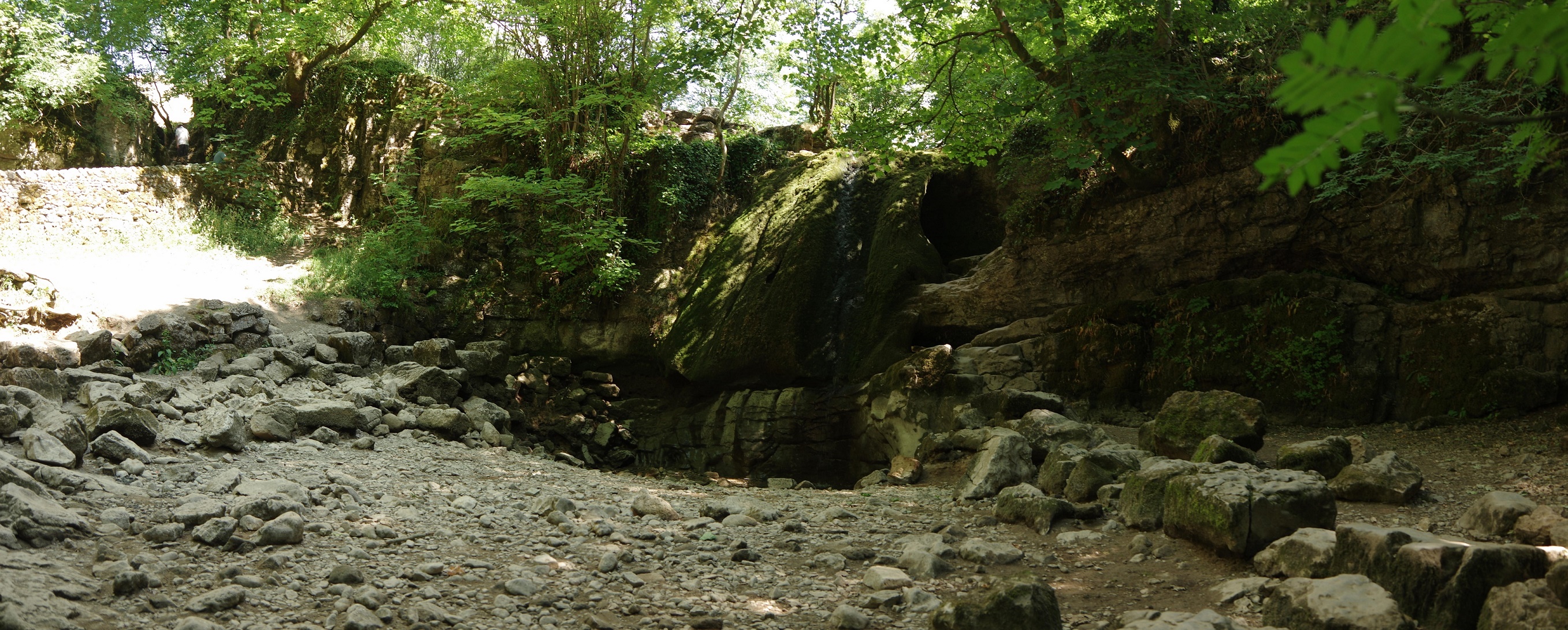

Janet’s Fosse is dry, though not to the bone – a dribble tumbles reluctantly over the tufa, supplying a much diminished splash pool – but I can stand on dry ground in the centre of what is normally a substantial, turbulent pond, perhaps a metre below where its surface would have been the last time I was here.
Gordale is even drier, nothing but a school party clinging to the rock face. I’m able to scamper up rocks that are normally drenched in a thundering cataract without a second thought, and onwards towards Malham Moor.
On this walk, I want to explore the high ground behind Malham Tarn, so I divert along the bridleway to Arncliffe through Great Close just as far as Back Pasture Hill, from where there’s a stunning view back towards Gordale and beyond to the slopes above the lower Aire Valley. Getting off the beaten track is worthwhile on its own merits for the peace and quiet and the chance to see a different view but turning back towards the Tarn, this little diversion comes with the added bonus of the sight of the lake still as a millpond, reflecting the marbled clouds so perfectly that approaching from above, the water’s surface might be mistaken for the sky itself, filling the frame around the silhouettes of trees.

Into the woods around the Tarn, the temperature drops by at least 10 degrees and everything is green – except for a stand of sapphire-blue Aconites in full flush. It’s one of the things woodland does incredibly well: moderating extremes of temperature and humidity.
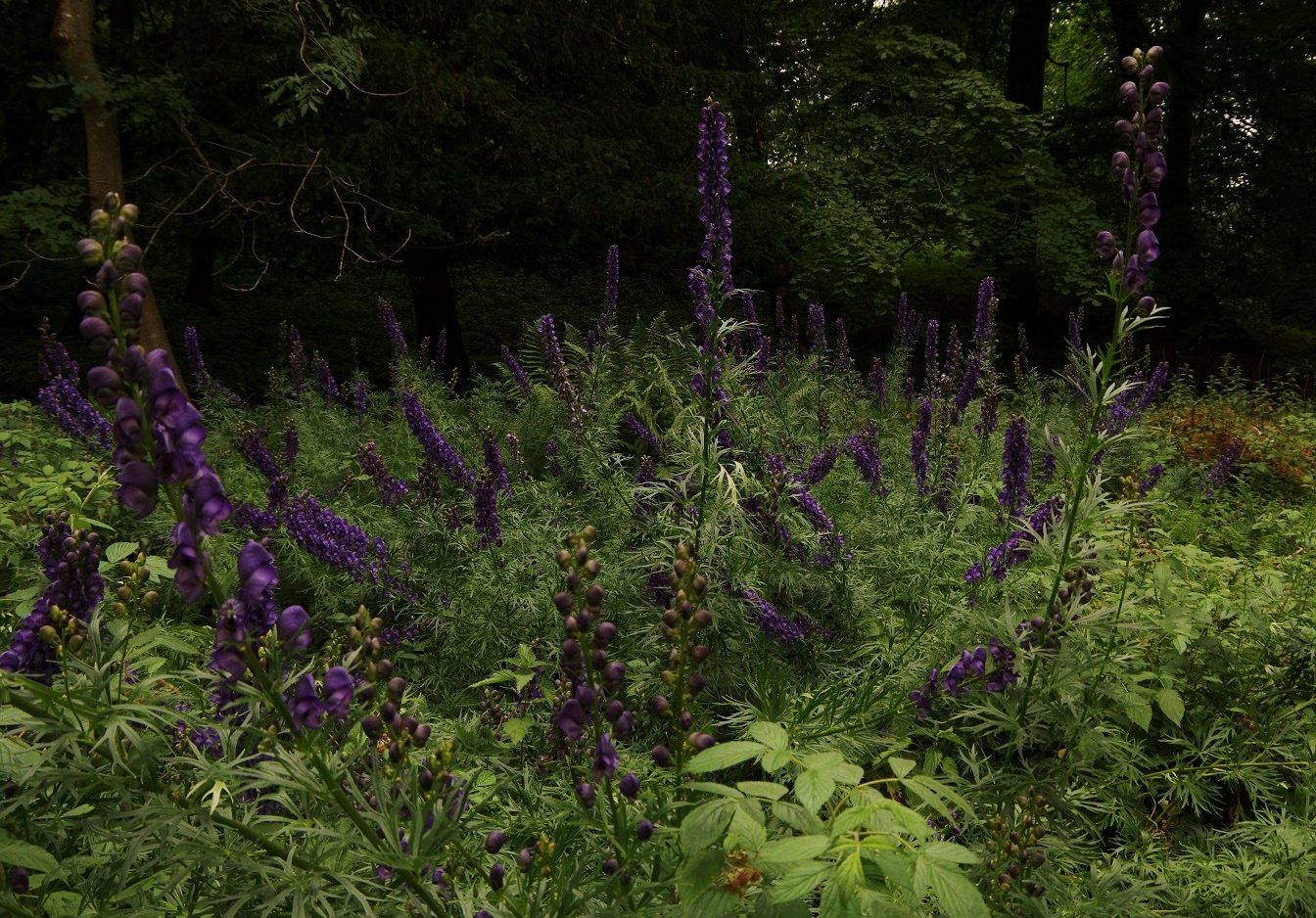
The contrast with the grazed moorland couldn’t be more stark and I’m led to wonder whether without our continued intervention along existing lines, these upland landscapes would ultimately revert to a patchwork of moors, meres, mosses and forest, and would be far more resilient as a result. Woods and wetlands intercept and retain vast quantities of moisture (reducing flooding in lowland areas), effortlessly support an incredible diversity of species, and – if managed forestry is also part of the mix – provide timber, fuel, fibre and food in variety. If only we had an opportunity to amend the systems of regulation, subsidy and cultural convention that define what we understand by the ‘Yorkshire Dales’ (other similar upland landscapes are available) I wonder what might be restored in these landscapes…

The furthest point of my walk before looping back towards Malhamdale is the Tarn Moss – a nature reserve within a nature reserve, comprising a peat bog on the fringes of the tarn, access to which is via a sinuous boardwalk path.

Flat and damp even after the drought, this intricate habitat sports a plethora of rare and common species and is currently bedecked in the emerging florets of Meadowsweet flowers and studded with Ragged Robin and Devil’s Bit Scabious flowers, each it seems being visited by its own personal fly.
It’s a long walk back to Airton but mostly downhill and I’m in no hurry. Passing by Malham Cove on the way feels like a happy obligation to an old friend – I don’t think I’ll ever tire of visiting it, whatever the weather.
Second life
Nine years ago today I nearly came a cropper in a freak accident on the road – freak mostly because of my extraordinary luck in escaping my upturned car with barely a scratch, considering the number of trees and roadsigns that might have brought the vehicle to a sudden and deadly stop instead of the relatively soft hedge that was the final resting point. I had bounced off a 4×4 that had pulled into the road too soon causing my small car to flip over against the kerb and send vehicle and driver spinning through the air in a state of shock and bewilderment.
These events are traumatic but can have meaning if we want them to. For me, my immediate realisation that I needn’t replace the car, since my living situation didn’t demand one was a huge relief. Over time, however – and quite a short space of time – something much more significant dawned on me. This event could be a turning point: a chance to reappraise my life, stop taking it for granted and above all stop waiting it out with no direction, no hopes and no sense of what I wanted to achieve.
It was then that I stumbled across my local Quaker Meeting. I had long since stopped attending churches through lack of interest in most of the ideas and traditions they appeared to represent (although I’ve a somewhat more rounded view now). In the silent hour’s meeting which I approached with some trepidation – not to say scepticism – I found an astonishing centredness that helped me both consider my own condition and turn outwards to the world. No longer did any particular belief system, rituals or traditions matter: only the unquestioning acceptance and openness of the circle of people in the room, whose individual ideas, longings and preferences could co-exist without hierarchy or favour. It was a revelation.
But the aspect of Quaker culture that spoke to me most profoundly and still speaks to me today was the idea that we should ‘live adventurously’. That I take to mean in its most complete sense – not the self-gratifying pursuit of exploration and thrills (though there’s nothing inherently wrong in a bit of that); instead owning the sense that if life has a purpose it is to be lived: to explore, yes, and to discover, but also to answer need, become vulnerable, build without knowing whether what you build will last, plant without knowing the tree will grow, express oneself creatively without needing the approbation of others, and to experience the marvellous in the colours, sounds, touch and smells of every day.
I often forget all of that. Fortunate then to live in a part of the world where I only need to step outside to be reminded of the glorious brilliance of being alive – and in the very spot that people have practised that consciousness for hundreds of years in the shape of the Quaker meeting and its predecessor dissident groups that first met here in the ‘barn in a field’ when that simple act was considered by the rest of society to be seditious and wrong.
So I thank that other driver – and the hundreds of people I’ve been inspired by to live adventurously over the intervening years – for giving me an entirely fresh perspective on life and above all, countless reasons to live it to the full.

 Airton Friends' Meeting House and Barn