Uncategorized
John Lambert, George Fox and the origins of Quakerism in Yorkshire
Many people responded to the distress and turmoil of the English
Reformation in the 16th century and Civil Wars in the 17th by focusing on their
religion. Some supported one or another of the creeds and systems of church
government that were being debated and fought over. Some wanted to purify the
national church by removing its unbiblical elaborations. Others, of whom there
were many in Yorkshire, experienced the immediacy of divine revelation.
Compared with people living elsewhere in England, Yorkshire folk were
notoriously ready to reject whatever felt like arbitrarily imposed authority.
While perhaps hundreds of people elsewhere in England identified themselves
as Seekers, apparently thousands did so in Yorkshire in the late 1640s. These
people knew of one another. They travelled to hear radical preachers and they
met, often in secret, for discussions and in silent waiting for God to send them a
new prophet who would show them how He desired to be worshipped. Some of
the larger and more active groups of Seekers were shielded from persecution by
local magistrates who had served in the Parliamentary army under Major
General John Lambert during the English Civil Wars.
John Lambert (1619 ~ 1684) was a figure not unlike the first President of
the United States. Well educated and fastidious in his tastes and interests, he
was an ambitious, relatively wealthy, upper class land owner. He was also an
extremely able soldier and statesman and a supporter of religious tolerance and
popular rights. He should be remembered and honoured for framing the English
Commonwealth’s Instrument of Government, which was the first modern
written constitution for a democratic government. Its wording influenced the
writers of the United States’ Declaration of Independence. Perhaps the most
significant difference between George Washington and John Lambert was that
Washington’s cause triumphed. Lambert was imprisoned for life when the
British Monarchy was restored in 1660. It was probably a few years before 1620
when John Lambert’s father, Josias Lambert, built or permitted Airton Meeting
House to be built on his land in Malhamdale. Outwardly resembling a barn, but
with its entrance concealed from public view and no door or windows facing the
street, the Meeting House could have accommodated 100 people. Most probably
it was a Seeker meeting place.
After a restless youth of work, self-education and travel George Fox
would have been ready to begin his life’s task. As he travelled through parts of
England including Nottinghamshire, Lincolnshire and Derbyshire in the late
1640s, he met like-minded friends among whom his presence sparked the
formation of a few small proto- or early- Quaker meetings. Then, in 1651, he
went northwards into Yorkshire, where in little more than a year’s time the
religious movement that was to become known as Quakerism burst forth more
than half-formed and almost fully fledged. The enforced stillness of almost a
year’s imprisonment in Derby in 1650 gave him time to consider his next
moves. After his release, he visited religious Seekers in the southern and eastern
parts of Yorkshire. He was in Beverly in June 1651 and in Balby near Doncaster
that December. Among other like-minded Yorkshiremen, he met James Nayler,
who had served as quartermaster under Lambert in the recent English Civil
Wars, and Richard Farnsworth, a young man of about his own age who had had
religious experiences very similar to Fox’s. Farnsworth was an ardent and
effective preacher and a leading member of a group of about 20 Seekers centred
around Balby.
Fox and these Seekers were united in their readiness to proclaim the
validity and power of unmediated religious experience. Their first practical act
seems to have been an attempt to increase their numbers by visiting and
preaching to other religious dissenters. The Balby Seekers including Nayler and
Farnsworth were already in contact with Seekers and Grindletonians who lived
in Yorkshire’s West Riding, many within a 25 mile radius of Skipton. Nayler
probably urged that an attempt be made to recruit the support of John Lambert.
In the event, Farnsworth was Fox’s travelling companion in late spring and
early summer of 1652 when they walked westward from somewhere near
Bradford towards Skipton, where they would have met Seeker leaders who must
have been as interested to hear what Fox had to say as he was to preach to them.
Among them would have been Thomas Taylor, who farmed land at Carleton. He
was reputed to be “President of the Seekers”. His brother was leader of the
Westmorland Seekers. The Seekers William Watkinson of Scale House,
Rylstone and his brothers soon supported Quaker meetings in Airton, Bradley
and Knaresborough. The Tennants were a large extended family whose
members farmed at Scar House at the top of Wharfedale, and at Kilnsey, and on
Malham Moor, and who also owned property in Skipton. A few years
previously, James Tennant had set aside land at Scar House for Seeker
interments. This became an early Quaker burial place; Scar House was an
important centre of early Quakerism. Other members of the extended Tennant
family were Grindletonians, that is radical preachers who emphasised the
primacy of Spirit-led religion while remaining members of the Established
Church.
When Fox and Farnsworth first arrived in Skipton, plans for a
midsummer yearly meeting of Seekers to be held near Sedbergh must have been
well advanced. George Fox was invited to attend a private meeting of the
Seeker leaders to be held in the home of Gervase Benson before or at the start of
their larger gathering. Permission for him to address the entire Seeker yearly
meeting may have been conditional on his persuading its leaders of the
appropriateness of his message. He then spoke to large crowds in the church, in
the church yard, and on Firbank Fell. The result was similar to what had
happened about six months previously when he met with the Balby Seekers.
Many, apparently including most of the Seeker leaders, accepted Fox’s message.
Fox and his friends united with the more numerous Seekers who brought with
them functioning systems of meetings and communication.
However, we are getting ahead of the story and must go back a few weeks
to ask what happened after Fox and Farnsworth met leading Seekers in Skipton?
Who or what attracted them to continue walking westward? During the 16th
century Reformation, almost all church livings – the rights to receive church
tithes and dues and to appoint parish priests – were confiscated by Henry VIII
and sold to whomever would pay a good price for them. Exceptionally,
Grindleton parish, 16 miles west of Skipton, retained the right to appoint its
own priest. Although the congregation and its priests were members of the
Established Church, they rejected many of its rituals. Grindletonian preachers
were repeatedly reprimanded by church authorities for not wearing surplices,
not using the sign of the cross when baptising infants, for preaching elsewhere
than in their own churches without being licenced to do so, and for allowing lay
women and men to preach and to pray aloud. Grindletonianism was widely
influential in West Yorkshire. If Fox and Farnsworth had hoped to persuade the
Grindletonians to leave the Established Church and to join with them in creating
a new religious movement, they were disappointed. After failing in this
endeavour, George Fox climbed nearby Pendle Hill, perhaps following the
example of Old Testament prophets who communed with God on hilltops. Later
that evening while in his room in an inn, he understood that his call was not to
the Grindletonians who were unwilling to leave the Established Church, but to
the Seekers assembling in Sedbergh, by whom he had already been invited to
speak. These Seekers were a great people waiting to be gathered.
Upon leaving Pendle Hill, Fox and Farnsworth probably went directly
towards James Tennant’s home, Scar House, at the northern end of Wharfedale.
The easiest walking route would have first brought them 14 miles from
Grindleton to the purpose-built Meeting House in Airton. Most probably John
Lambert was then in residence in Calton and almost certainly George Fox
would have attempted to speak with him. Perhaps Fox brought a letter of
introduction penned by James Nayler. He may not have persuaded Lambert to
become a Quaker, but it was probably Fox’s influence that ensured the Lambert
family’s protection and their permission for Friends to use the Airton Meeting
House for almost half a century before it was purchased from them by William
and Alice Ellis in 1700. While on his way to Sedbergh in June 1652, George
Fox may have preached in Airton Meeting House. Two years later, in 1654,
William Watkinson of Scale House, Rylstone, was convicted for riding his horse
to a Quaker meeting on a Sunday. He must have ridden the 5 miles to Airton, as
there was not then another Quaker meeting at a convenient distance. These
incidents date the beginnings of Quakerism in the Yorkshire Dales.
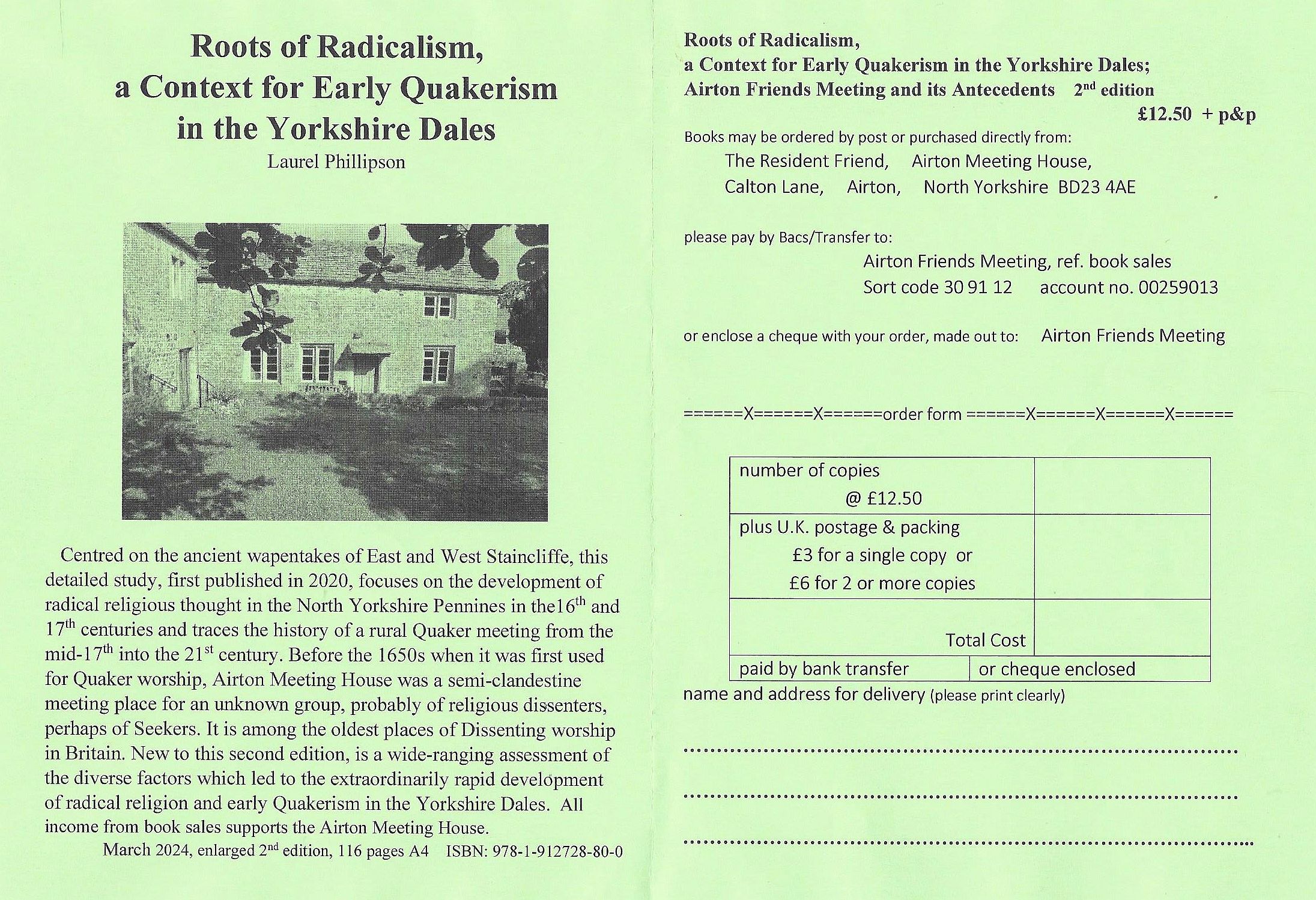
The points mentioned here are substantiated in two books, Hidden in
Plain Sight and Roots of Radicalism, which may be purchased from the
Resident Friend at Airton Meeting House. All income from their sales helps to
maintain this interesting and historically significant building.
Laurel Phillipson
June 2024
Quaker Accommodation UK
Other Quaker residential centres you might enjoy
A community of Quaker centres, each with its own unique character and ethos, but all adhering to the core aims of Hospitality, Integrity, Principle. These underline an open and rich welcome, which we hope will reward the casual visitor as well as the dedicated seeker of retreat.
Claridge House is a Victorian House based on 2 acres of woodland garden, in Lingfield, Surrey. Our charitable aim is Rest and Renewal and our courses and retreats are focussed to provide just that. B and B’s are welcome too. Quaker owned for 70 years and vegetarian all this time.
We have 10 guest rooms in the main house as well as the self-contained Courtyard Rooms. Two rooms for courses with access to our peaceful gardens, as well as the Quiet Room/Library which is used for Meeting for Worship on Sundays. Our hospitality and fare are renowned. We are accessible to Gatwick airport as well as Lingfield station (45min from Victoria); located in Surrey Hills and conveniently situated close to National Trust and English Heritage properties.
Glenthorne Guest House and Conference Centre, Grasmere, Cumbria
Glenthorne is a long established guest house and meeting place in Grasmere in the heart of the Lake District. It is open to anyone who is seeking
a relaxed welcoming atmosphere, comfortable accommodation, and delicious home-cooked meals in stunning surroundings. They aim to meet the differing needs of all their guests in a peaceful atmosphere with Quaker values and ethos
Swarthmore Hall, Ulverston, Cumbria
Experience a change of pace in the quiet, comfortable and beautiful setting of Swarthmore Hall. Building on its early Quaker heritage, it is a place of hospitality and a living spiritual centre. Ensuite accommodation (including two accessible suites) can be booked on room only, bed and breakfast or self-catering basis, with full board available for group bookings. There is a residential programme of courses, retreats and pilgrimages. Day visitors can enjoy tours of the 16th Century historic house, Barn Café, shop and gardens. The conference and meeting rooms are also available for hire with half day and day package options. For more information please look at our website:www.swarthmorohall.co.uk or contact us: 01229 583 204 or, info@swarthmoorhall.co.uk
Woodbrooke, Selly Oak, Birmingham
Woodbrooke is situated in 10 acres of organically managed grounds and is renowned for the warm, welcoming atmosphere. You can retreat from the hustle and bustle of the world whilst soaking up the atmosphere of George Cadbury’s former home. There are 60 bedrooms available with a mix of single, twin, double and family rooms. All have tea and coffee making facilities and a desk for working independently. Most of the bedrooms are ensuite, the rest have modern bath and shower facilities nearby. Woodbrooke is also a centre for learning and their programmes seek to support, inform and transform Quakers and others as individuals and communities.
Charney Manor, Charney Bassett, Wantage, Oxfordshire
Charney Manor is a 13th Century Conference and Retreat Centre owned by the Religious Society of Friends (Quakers) in a village in the beautiful Oxford countryside. Charney Manor is open to guests for B&B and offers simple, comfortable accommodation of single and twin bedrooms. Most bedrooms are ensuite, with two having private bathrooms. All bedrooms come equipped with tea and coffee making facilities, towels, complimentary shower gel and most have exquisite views of the gardens.
Unlock the Power Within: Join us in the Experiment with Light!
Next event 31st of August, 7pm-9pm. Then the last Thursday of each month.
Refreshments available. All welcome.
Dear Friends and Seekers of Inner Light,
Are you ready to embark on a journey of self-discovery, spiritual growth, and profound transformation? If so, then I invite you to step into the realm of the Experiment with Light.
In a world bustling with noise and distractions, where constant demands tug at our attention and peace seems elusive, it becomes crucial to find a sanctuary within ourselves. The Experiment with Light offers just that—a space for us to reconnect with our inner wisdom and tap into the boundless wellspring of love and guidance that resides within.
Drawing upon a Quaker practice, the Experiment with Light is both simple and profound. It is a contemplative and meditative approach that allows us to delve deep into the core of our being, where true understanding and enlightenment await. You don’t need any special experience or background to participate; all you need is an open mind, a receptive heart, and a willingness to explore.
The Experiment with Light practice employs a series of gentle prompts or ‘queries’ that invite us to reflect upon and investigate particular aspects of our lives. Through these prompts, we gain insight into our relationships, personal challenges, and spiritual aspirations. We learn to identify the patterns that shape our thoughts and actions, and we uncover the hidden barriers that hinder our growth.
But the Experiment with Light is not just about self-reflection; it also nurtures our connection with the divine. As we open ourselves to the source of all life, we discover the sacred presence that pulses within and without. We begin to sense the interconnectedness of all beings and the universal wisdom that flows through us all.
In coming along to our Experiment with Light group, you will find a warm and welcoming community of fellow seekers who share a common goal: to deepen our understanding of ourselves and the world around us. We gather to listen and be heard, to support and be supported, and to inspire and be inspired. Together, we create a safe and nurturing space where vulnerability is embraced and growth is celebrated.
Experiment with Light is often practised in Light groups, but it can also be undertaken as a solo discipline and it is not necessary to be a Quaker to practise it. Recordings of the different versions of the meditation are available on CD and as downloads from the Experiment with Light website. The website Experiment with Light also provides details of resources and events as well as the guided meditations. It also holds the latest online editions of the Experiment with Light Journal.
The Experiment with Light process can be separated into four main steps, once you have accepted an invitation to be still:
- Mind the Light (pay attention to what’s going on inside you, particularly where there’s something that makes you feel uncomfortable)
- Open your heart to the truth (don’t run away from anything that’s difficult or that you don’t want to face, but keep a little distance from it: ‘be still and cool in thy mind’)
- Wait in the Light (be patient, let the Light show you what is really going on, ask questions if what is being offered to you isn’t clear or you want to know more, and wait for the answers to come, don’t try to explain)
- Submit (accept and welcome the information or images, and the insights, dreams and perceptions that may come later, and allow them to show the truth)
After the Meditation of 40mins, we immediately have a 20min period of self reflection where we do not engage with others, but may get a brew, write, draw, or just have time to ourselves to absorb what came up. We then gather into small groups of three or four to enable sharing, no one is to offers advice or discuss what is said we are to allow the Light to work within us. We act as witness and listeners one to another this is all. You do not have to share, but may offer more time to others,15-20 mins. We then come back together as a whole group and time is given to hear contributions from your own experience to the bigger group if you wish to. There is then a brief plenary looking towards the next event and bringing the experiment to an end for this month.
The Experiment may: Help to cultivate a deep sense of inner peace and tranquillity. By quieting the mind, connecting with the divine presence within, and letting go of worries and concerns, participants can experience a profound sense of calmness and serenity.
Increased self-awareness: This practice encourages self-reflection and introspection, enabling participants to gain deeper insights into their own thoughts, emotions, and behaviours, that can lead to personal growth and positive transformation.
Enhanced spiritual connection: provides a space for individuals to connect with their spirituality and deepen their relationship with the divine. Through meditation and contemplation, participants can experience a sense of oneness with the universe and a deeper understanding of their spiritual path. This connection can bring about a greater sense of purpose and meaning in life.
Aid emotional healing and release: allows individuals to dive into their innermost emotions and address any emotional wounds or traumas that may be holding them back, in keeping a little distance to enable clarity. By acknowledging and processing these emotions in a safe and supportive environment, participants can experience emotional healing and release, leading to a greater sense of emotional well-being and freedom.
It is an offering of community and support: of like-minded individuals who are also on a spiritual journey. Offering a space for sharing experiences, insights, and challenges, fostering a sense of belonging and connection. The collective energy of the group can provide additional support and encouragement on one’s spiritual path.
It is important to note that the benefits of the Experiment with Light practice will vary for each of us. It is a personal and experiential journey that allows individuals to explore their own inner landscape and connect with their spirituality in a way that resonates with them.
For more information please call Cindy at the Airton Meeting House on 01729 900018.
Airton Meeting House Update
Airton Quaker Meeting House: an oasis of peace and tranquillity for all
Services every Sunday at 2 pm… and simple overnight accommodation in the Dales
There it is. Easy to miss. Almost hidden in plain sight: the ancient Quaker Meeting House next to the Green in Airton in the Yorkshire Dales. In the course of its long history spanning around 400 years it has seen many ups and downs. Even since the Second World War its fortunes have waned and waxed.

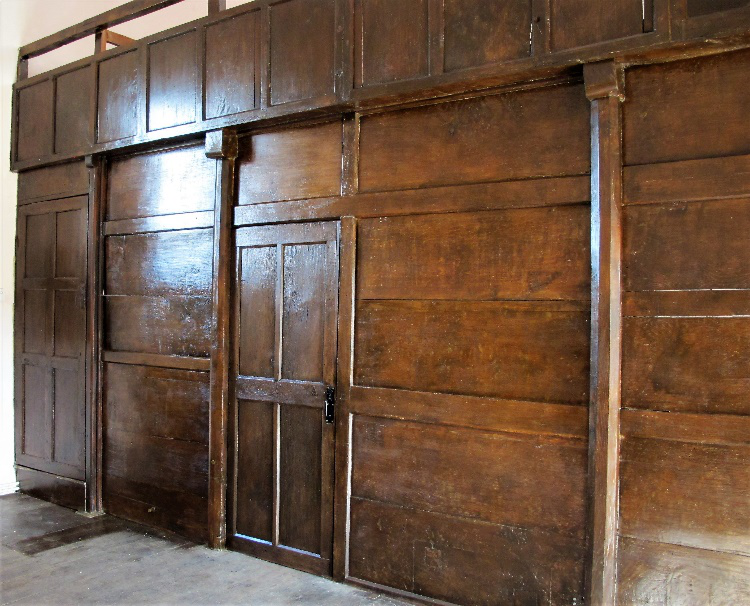
For about two years during the Second World War, the Meeting House provided accommodation for two evacuee families from Liverpool. After the war, Quaker numbers and attendances at meetings for worship declined and the building survived more by neglect than by good care. At some stage, all the historic woodwork inside, including the ancient rustic oak screen, was painted in battleship grey.
Although the Barn continued to be used as a much-loved hostel by young Quakers and other youth groups, regular worship was discontinued and the Meeting House began to deteriorate fast, even though well-attended meetings for worship continued to be held two or three times a year. By 2000, the Meeting House was partly unroofed, its gallery dangerously unsupported, and there was much damp penetration through its cracked walls.
At that time, a few Quakers in the area who recognised the quiet simple beauty of the Meeting House decided to reinstate regular worship at Airton and, over the next twenty years, raised sufficient funds to repair and restore the property. After several strenuous fundraising campaigns, the Meeting House was re-roofed in 2005 with further restoration and repair work in 2008 and over the last two years. Over the same period all the other buildings within the curtilage including the cottage and the impressive wall along the road were restored. Once the whole complex had been largely returned to its eighteenth-century configuration and careful research had shown the unique historic significance of the buildings, Historic England awarded the Meeting House an upgraded II* listing.
Over the last twenty years or so, regular worship continued in the Meeting House every second and fourth Sunday at 3 pm. In addition, an increasing number of events took place here, ranging from drama and talks to much loved recitals. And then came Covid, making progress very difficult. When the wider community emerged from it all, things were different and more uneasy.
However, by the middle of 2022 all the work on the Meeting House had been completed. The old rustic oak screen had lost its nasty battleship-grey coat of paint and was now fully restored looking as good as it must have done over 300 years ago. New and more comfortable seating was installed and the life of this important Quaker Meeting took on a new upswing.
The uncertainties of Covid had shown many of us the importance of community, but also of having a place of safety, refuge, tranquillity and togetherness. Meetings for worship take place every Sunday at 3 pm, always followed at 4 pm by a convivial gathering in the Barn for tea/coffee and usually cake.
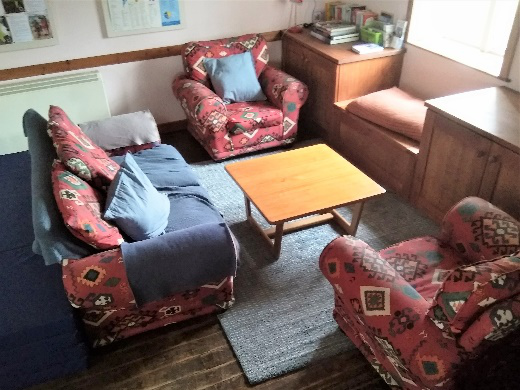
The Barn is also open again for simple overnight accommodation where our Friend in Resident will welcome guests and visitors from all over. The Barn upstairs is mainly geared towards families and groups whereas the separate accommodation downstairs is ideal for one or two people. Our website (https://airtonbarn.org.uk/) will be updated soon with more photos but do have a look, it already gives you a good idea what it will be like to stay with us.
 Airton Friends' Meeting House and Barn