Finding the blue monarch of Spring
It’s the big ticket sights that mostly draw flocks of tourists to the Dales – the spectacle of Malham Cove or Gordale Scar, the aloof majesty of the three peaks, the grandeur of Wharfedale… But for me the real charms of the area lie in the rich diversity of its everyday landscapes and the extraordinary lesser known places that for the most part are bypassed by the crowds.
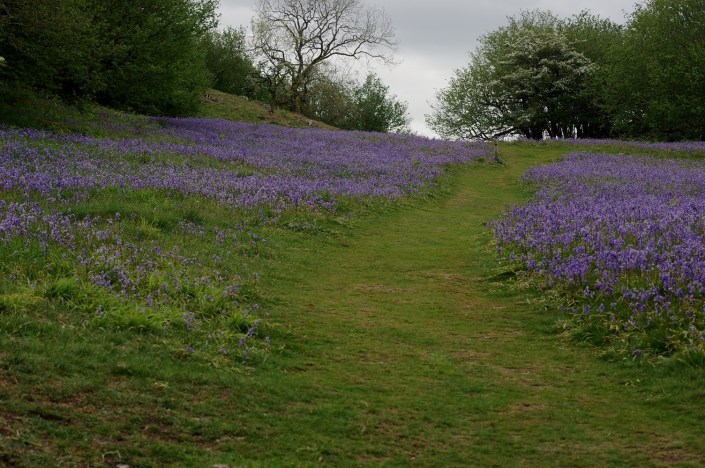
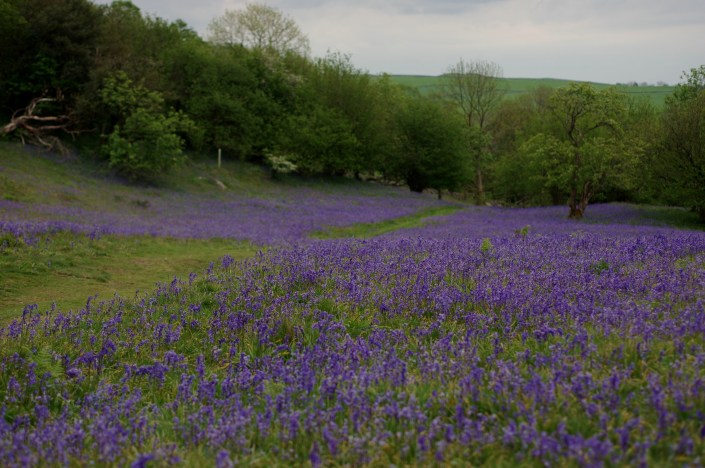
 Around 10 miles west of Airton, between the villages of Austwick and Feizor a craggy hillock rises unobtrusively from the plains below Ingleborough. At this time of year its flanks blush greenish blue as that most English of springtime scenes, the bluebell wood, reaches its annual climax. So, having been tipped off that the display is a superb one this year I head to Oxenber Wood on a spare afternoon hoping I haven’t already missed the show.
Oxenber and Wharfe Woods now clothe the former Austwick township quarry – a sort of stone larder used by the people of the village in the 19th century – also historically managed as wood pasture with coppicing. The combination of the limestone formation (often breaching the surface in the form of limestone pavements), this historic pasture management and its elevation above the surrounding intensive pasture has created a unique, species rich ecology now designated as a Site of Special Scientific Interest (SSSI). Marvellously, it’s also one which the public can enjoy via a good network of waymarked paths.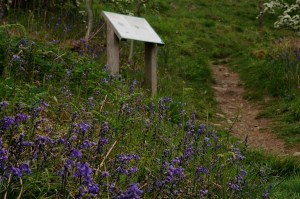
Entering the wood by one of these narrow, steeply climbing dirt tracks is like crossing the threshold between two worlds, swapping the simplified ecology of the grazed field for a much more complex environment, full of niches and hollows filled with uncountable variants of plants and animals.  It’s not quite wild – ongoing light management prevents that and for good reason, as occasional grazing and coppicing ensure there is sufficient year-round light for rare ground-flora to survive. But there’s enough wilderness about it for nature to function as nature does.
The wild is nature’s cauldron, where species mingle, adapt and evolve. In the fertile open spaces, variation flourishes whilst in the difficult marginal niches, differences are exploited and particular characteristics promoted. Cast a brief glance over this woodland, perched on a rocky hillside with stones breaching the surface everywhere, and you’ll see a reserve of biodiversity, not just of different species but within the same recognisable species – tall / short, deeply coloured / pale, robust / slender… Here are plants rarely seen elsewhere and new to my eyes; there a solitary bee in unfamiliar livery. Here a splendid orchid; there a crab apple in fabulous blossom. In short, this is a thrumming pool of genetic diversity, all too small on its own but potentially contributing ecological resilience to a wider network of similar places and between them to the landscape in general. For however sophisticated our technological approach to landscape and agriculture, its resilience still depends upon the ecosystems services provided by species found only in the natural world. Imperil them and we imperil ourselves.
In the world of ecology, distinctiveness matters, because the interrelationships that make a habitat tick are finely tuned to the special characteristics of the organisms that have co-adapted in it; and because introduced varieties of the same species found locally but with dominant habits both disrupt those interrelationships and reduce the overall genetic diversity of a species. That reduces the resilience of the species to pests and diseases, in turn undermining the resilience of the habitat and ultimately that of the bigger ecosystem in which we live known as planet Earth.
 That’s one reason why these almost-wild places are so precious. Another is the sheer sensory delight and refreshment they give, free of charge, to anyone who seeks them out. This season’s special gift is the abundance of colour fizzing from the lush energetic new growth of the woodland floor. As I wander, my eye is caught by all kinds of spring flower – creamy primroses and sulphur cowslips, wild garlic, dog’s mercury, cow parsley, cuckoo flower and speedwell. But the monarch of the spring, sweeping all before its enveloping train is the bluebell. Their slender, graceful stalks and nodding, dark bells seem to cover every patch of ground. Here but for a moment, they paint the hillside in regal livery, commanding attention to some wordless ceremony and are gone. They and their admiring public will be back to relive the scene next year. Until then we must content ourselves with memory.




What has silence ever done for us?
If people in general know anything about Quakers it’s that we tend to sit quietly a lot. I mean, really quietly. The recent, hilarious depiction of a Quaker Meeting on the BBC’s ‘Fleabag’ by genius comic writer-actor Phoebe Waller-Bridge sort of celebrates whilst gently teasing this quirk of Quaker worship, brilliantly showing how counter-cultural it is to sit in a room together not talking.
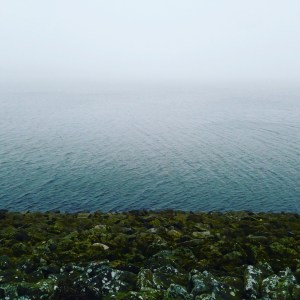
Silence is something in abundance in this part of the world – in the evenings, anyway – so much that sometimes the whole place can feel like one extended Quaker Meeting. But listen hard and there are plenty of conversations going on: bird to bird, fox to fox; planes transmitting souls across the sky; climate and soil in the endless dance of life. All players making themselves known, all asking questions, some receiving answers. But apart from the ticking clock and the scuttle of fingers over a keyboard, my world is silent this evening.
For most people in our society, silence is in far shorter supply. We’re bombarded with information, data, opinions, noise. Things we must know, ideas we should follow. The world says ‘Listen to me! I know what you need, even if you don’t, and I have the answers!’ Except mostly it doesn’t. Then it gets demanding: ‘Like me! Decide what you think! Make a choice!’ The only way to shut it out is to confront the wall of sound constantly bearing down on us by turning up our own volume – of speech, noise or music – making our own definitive statements, finding better arguments than the ones that are trying to win us over, or just bore us with their noisy irrelevance.
There would be more than enough of this noise if it only came from politics, work, fashion and entertainment; but into this cacophony steps religion – another voice, insisting on another set of beliefs, practices and choices. So with the world in a state of confusion, as soon as someone enters a service of worship, they’re given yet another position to agree or disagree with above and beyond any ethical standpoint they might have formed on their own. Lines are drawn and the question is asked ‘are you in or out – with us or not?’ Whilst valuable for some, for many people this extra layer of certainty is the turn off that stops them questioning at all.
Which is why I’ve come to appreciate the silence of Quaker Meetings more than any other aspect of Quaker life. A natural fidget, it takes me a good while to get settled but once I’m in the space so to speak, I find the noise of my thoughts start to diminish, my petty concerns one by one unravel and my sense of appreciation increase – for the good things of life, for the hopes I carry and crucially, for the people in the room with me.
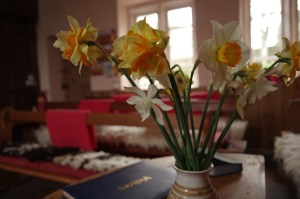
Occasionally, someone will share a thought they think might be useful for the others (something a bit more profound than ‘I think I’ll go home in November’ – funny as that was Phoebe!) and then the disturbance to one’s own thought processes becomes valuable in its own way; but often the silence continues for the whole hour. And afterwards, calmer, happier, stronger I’m better able to articulate the things that need to be said, take part in the discussions that need to be had, act on what needs to be done.
So that’s why in my view, in times of social tension, political challenges, economic turmoil and ecological breakdown, the silence of Quaker Meetings might just be a radically important offering that Quakerism can make to society in general. No doctrinal demands, no complex ritual practices, no hierarchical powerplay – just a space in time when everyone is equally valued, equally significant and equally eloquent. A space into which all are welcome and from which all can exit equipped by silence to participate in the work that reconnects people with people and people with the universe we inhabit.

When walls need to fall
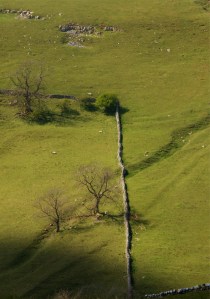 The Yorkshire Dales wouldn’t be the same without its rustic drystone walls, winding alongside roads and trackways, zig-zagging precariously up improbable slopes, patchworking the landscape in patterns often indecipherable to the amateur eye. Stone on stone, carefully placed and replaced generation after generation, until for some the need for the wall disappears and time undoes the years of labour, leaving a slowly dissolving trace on a hillside reclaiming its substance for itself.
Walls give us definition and function, within an otherwise unscripted landscape. In the presence of walls we know where we stand and whether we’ve the right to stand there. Before the enclosure acts of the 18th century, walls and hedges were less common; according to the late Oliver Rackham, historian of the British countryside, as many field boundaries being created between 1750 and 1850 as in the previous 500 years*. Then the 20th century fell out of love with them, with hundreds of thousands of kilometres of hedgerow being grubbed up between the 1980s and the present day.
We may be less enamoured with the old materials for boundary-marking but the urge to define and defend boundaries seems stronger than ever in the present age. And the walls and fences being erected around the world in the name of that definition are higher, less bridgeable and more aggressively defended than ever before. From the convoluted security barrier winding through the Occupied Palestinian Territory of the West Bank cutting communities off from their farmland, neighbours and key transport routes; to the barbed wire migrant fences erected along the national borders of European countries in 2016; and the proposed wall-that-must-be-built for the United States to cower behind in apparent fear of the neighbouring states to the south – our love affair with national definition and protection from the other seems to grow in intensity the more we discover that in human terms there actually is no such thing as the ‘other’.
 We’ve been here before of course – Berlin, Hadrian, the Great Wall of China: monuments to fear, control and yes to some extent the necessity of security. But the reasons behind all historic walls have proved as transient as the people whose movement they sought to prevent.
I will always remember the reply of my Berliner host family in 1987 when, too young to know how little I knew, I asserted that all empires and governments fall, so the wall would eventually come down. ‘No, this will never happen,’ they said. Two years later I stood transfixed in front of the TV, tears streaming down my face as I watched a human wave break over the hideous structure, carve chunks from it and roar in triumph as they deprived it of all meaning.
And so we can again with the walls of our time – if we remember that the people on the other side of them are as perplexed, anxious, hopeful, loving, creative, determined and ordinary as we are. That starts with hearing their stories. When Leeds based Sound Company Choir visit us on Saturday 23rd February we’ve a chance to do just that. Come and listen at the walls – you might be surprised what you hear.

*The Illustrated History of the Countryside, Oliver Rackham / Weidenfeld & Nicolson Ltd 1994, p.81
The best laid plans…
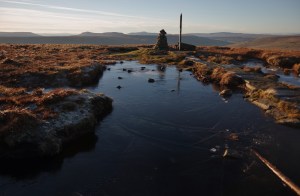
I don’t make new year resolutions just as I try not to make false promises… But a spectacular walk up Buckden Pike on Christmas Eve had me determining to get out onto the hills more, by foot or on bike, however full or empty the inbox is. Walking in particular isn’t just exercise for the body – some of my best ideas occur to me on a good walk, as though the rhythmic tread helps to straighten out the thoughts into usable strands, in a similar way perhaps to the effect of a good night’s sleep.
So this week I took the bike for its first spin of the year, heading up beyond the Cove to the bridleway across to Arncliffe. It’s a bright, cold day and the going is mostly dry except for a few muddy and frozen puddles around field gates, so all’s set for a modestly challenging, if more often leisurely, cross-country ride.
I’m less than a mile out from the Malham Tarn road when disaster strikes: a sharp click and suddenly I lose all traction and come to an ungainly stop. Looking down I see the chain trailing uselessly behind the bike, snapped clean into a single string. I knew I should have replaced it weeks ago…
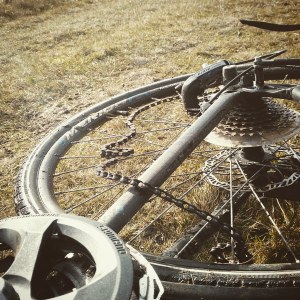
There’s nothing for it but to trudge back along my route and ponder the perils of procrastination – but not before enjoying a chilly picnic lunch by the shore of the Tarn, which is looking decidedly plumper and blue than the last time I wandered this way (see this blog for 16th July). May as well, since I’m in the neighbourhood.
The incident calls to mind a similar occurrence from a few years ago.
When travelling in south-west China I once hired a bike for a day’s exploration around temples and villages. Towards the middle of the afternoon just as I was pulling up the first hill of the day the chain gave out and with only a couple of hours before needing to re-join my group I had 15k to cover with only my feet and gravity to keep the show on the road. I tried thumbing lifts from passing open-backed vans but to no avail. Still, gliding downhill at a leisurely pace without the turning of pedals or the background whirring of gear wheels is about the most relaxing way to travel I know.
I remember this as I roll over the undulating road from the Tarn back to Malham and feel a certain kinship with people getting around on bikes the other end of the continent and the rest of the world for that matter.
And I put aside my plans to ride the bridleway to Arncliffe for later in the year. After all, had the chain snapped nearer to the furthest point of the trip, I’d have been walking home well into the night – something that would be much more enjoyable on a summer’s evening. Now there’s a pleasant thought for a cold day in January…

Christmas every day
Last week someone handed me a Christmas card whilst almost apologetically commenting that he didn’t know whether ‘your lot’ do Christmas but ‘here you go anyway’. My lot being Quakers. Well, yes and no…
It’s true that just as Quaker meetings in the don’t normally involve symbols or set prayers, they also generally don’t feature the marking of any festivals or saints days. Today this is justified by appeals to our ‘testimony’ of simplicity; but its origins lie in the rebellious nature of the Quaker movement in the context of the religious turbulence of 17th century England. One of many ‘diy’ congregational societies formed at the time, its members sought a means of exploring their faith away from the authoritarian oversight of ministers and the trappings and layers of church traditions. In doing so, groups like the Quakers saw themselves as ‘friends of the truth’ and set about forming an understanding of Christianity drawn from what they read in scripture enlightened by their own insights. When it came to the question of festivals and Christmas, seeing no basis for the annual celebration of Jesus’ birth on a particular day in winter, they simply abandoned the idea as a religious prospect.
So this sense of detachment from the significance of particular times and seasons is written into the DNA of Quaker worship and, for many Quakers over the years, interpreted strictly in their daily life as well. But it would be incorrect to characterise contemporary Quakers as puritan, and I’ve certainly never met any who are immune to the Christmas spirit, or the comings and goings of times and seasons throughout the year. Far from it: we might not decorate our Meeting Houses but you might find a ‘programmed’ Meeting for Worship here and there where the odd carol is sung, mince pies are enjoyed afterwards and yes, Christmas cards exchanged.
So what is the deal with Quakers and Christmas (and Easter, and any other national holidays)? I can’t speak for every Quaker but the way I see it is this. Festivals are a way for us all to unwind, celebrate each other, pause for breath, look back on our achievements and any number of other good and socially necessary things. It just so happens that our major winter festival got wound up with the celebration of the nativity and became a time when the church focusses on Jesus’ birth; and the fact that this still permeates the secular celebration of Christmas is testament to the power of the story at its heart.
I see no reason to turn away from the telling and retelling of that story at this time of year; but to be conscious of the distance between the way in which it is commonly told and the likely facts of its origins or the implications of its message. It doesn’t matter when Jesus was born. It does matter that the narratives we have in the gospels have him born into an ordinary family of no status or wealth, outsiders far from home, with the birth being announced first to shepherds – workers doing one of the least respectable jobs available at the time. It matters that the next people to notice were foreign travellers, looking for meaning in cultures beyond their own and seeking the common ground between those cultures. The inference is clear: what follows in the life of this remarkable human is a message for all people of whatever rank or background. Whether we’re interested in that message and what we make of it is up to us – and our conclusions are for life, not just for Christmas.
 Airton Friends' Meeting House and Barn