Making these walls ring with music and silence
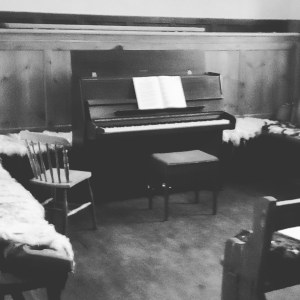
Just over a year ago we acquired a piano with the help of the Yorkshire Dales National Park Sustainable Development Fund. Perfectly normal for a venue of course but something of a departure for a Meeting House that has been host to silent gatherings for nearly 4 centuries.
Silence is a valued commodity for Quakers, so what was the appeal of a piano for the small group that regularly meets here? After all, we don’t make much use of the instrument ourselves – a fine thing though it is.
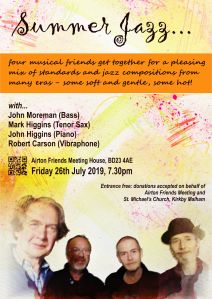
In the past year we’ve been treated to a wide range of work – jazz, new compositions, spiritual songs and stories, solo and chamber choir recitals, as well as drama and monologue – some private, some public. From the notes in the visitors’ book, the occasional tourist scratches a musical itch by playing the piano as well.
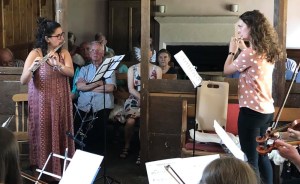
For me, music is part of the fabric of living: woven into heartbeat and breath, available to help express instantly the desires, elations, traumas, rages and reliefs of the soul. Growing up as a piano student, my piano quickly became confidante and mouthpiece: a prosthetic emotional sounding board. The immense value of this particularly to young people can’t be overstated and it saddens me greatly that music has been one of the first casualties of cuts in education budgets.
The 19th century Quaker poet John Greenleaf Whittier wrote the verses which included words that would become the hymn ‘Dear Lord and Father of mankind’ – somewhat ironically as it would turn out – as an entreaty to people to ditch elaborate ceremonies and noisy hymns in favour of the benefits of quiet reflection. But the experience of listening to or participating in music is such a richly rewarding one, so why would anyone want to exclude it from the heart of community life?
I don’t have an answer either for Mr. Whittier or for anyone who finds Quakers’ aversion to music in worship odd. But I do know what music can do and what at best it represents. As with all the arts, music somehow expresses truth more eloquently than a whole library of words. Melody, harmony, rhythm and texture all speak to the soul, giving voice to inner longings, joys and regrets, grounding the listener’s experience in the shared humanity of composer and performer. A well-crafted piece of music appeals across cultures and throughout time, dissolving perceived boundaries of place or people; and when performers join together to create music, it demonstrates the heights to which people in co-operation can rise.
And that would perhaps be all, except for one component of music that’s often forgotten. The truly heart-stopping moments in music often come when the instruments stop playing, if only for an instant. Every great performance is framed by silence, permeated by musical silences and in fact at its most translucent when silence is part of its texture. Those silences are the canvas on which the piece is painted, the questions it attempts to answer and the material out of which it is carved.

So amidst all the beautiful, inspiring and uplifting music of religions from around the world, perhaps there is after all a place for a kind of faith that is expressed in silence: one which offers an uncrowded space, in which the music of the soul can flow unconstrained and in which we are all performers regardless of the instrumentation of our lives.
Tell your leader, this is the People’s Priority now
 The following open letter was sent to Julian Smith MP shortly after the election in December and subsequently published in the Craven Herald under the curious title ‘I have questions for our re-elected MP’. These are not questions; they’re instructions – delivered from an electorate that has shown itself far ahead of the government in its concern about climate change.
Dear Mr. Smith
I note your success in securing re-election as the parliamentary member for Skipton and Ripon and write to offer some thoughts on the direction of the government of which you are now a part.
I’ve no doubt that you’re a hardworking, dedicated constituency MP and I’ve appreciated your willingness to engage with constituents’ concerns and respond to questions, often in some detail. You clearly also have the political support of the majority in this constituency.
The same may not however be said of your party with respect to the national picture. The vagaries of our system of democracy invariably deliver governments elected on a minority of the popular vote and the 2019 election is no exception. Under normal circumstances, those of a different view can hope that balance will be maintained by a swing towards their preferred choice at the next opportunity. Voters at least have the opportunity to participate in that uncertain and unequal process.
These are not, however, normal circumstances. We’re facing a global crisis of unprecedented proportions, in the face of which action of unprecedented range and rapidity is required. That challenge is the climate emergency, confirmed as a political priority for the UK in Theresa May’s last few days as Prime Minister.
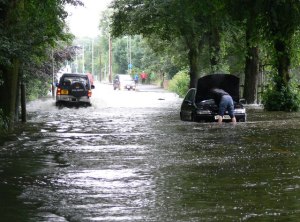
The first duty of government is the security of the people, and climate instability threatens our security as surely as any other issue. Whether through coastal erosion due to rising sea levels, increased intensity of flooding events, pressures on food and energy production, increased vulnerability of international food systems, social breakdown in regions of the world most affected and the resource-driven conflicts that ensue, the UK is by no means immune to this, humanity’s greatest challenge.
Conversely, our economy – the sixth largest in the world – has often demonstrated its capacity for rapid change in the face of shifting global realities. We possess the capacity both to develop and benefit from new technologies, best practices and creative ideas in ways not always available to less developed economies. Our history as the cradle of the industrial revolution that seeded climate change is clear. It is our responsibility to lead the world in the creation of a carbon-free economy, supporting international efforts by disseminating these technologies and practices wherever they are relevant. The opportunities at home for a rejuvenated carbon-free economy and radically improved environment are immense. We may be already committed to achieving that by 2050; but the global target is unlikely to be met by all nations. Since we can act and change more rapidly, then we should.
Your party’s manifesto was notably light on ambition concerning the climate emergency, as evidenced in the analysis carried out by Friends of the Earth. Your leader showed his disinterest in the subject by refusing to attend the leaders’ debate focussed on the issue. Yet the majority of electors voted for parties with substantially more radical approaches to climate change.

There is no time to wait till the next election. The emergency is now. Tentative, baby steps will not do. Your government must lead – first by engaging with all positive ideas, including those put forward by your opponents, then by implementing a radical, holistic plan with as much urgency as is governmentally possible, testing every policy with respect to its climate impact.
Finally, although I disagree with your politics I wish you well in this term of office as MP and in whatever role the Prime Minister chooses to give you. I recognise your good intent and trust that intent will help you listen, reflect, challenge where needed and act in good faith. Your leader is patently fallible, appears utterly ill-equipped for his office and in need of guidance from wiser heads. If he wishes to speak credibly about ‘healing’, he must put aside mocking language, disrespect to minorities and derision towards those sections of the public whose commitment to social and environmental justice he finds inconvenient. Above all, he must speak truthfully. The government he leads and in which you serve must be the servant of the whole country, not just the minority which elected it. In the face of the urgent issues of our time, that is truer than it has ever been.
Yours sincerely,
Simon Watkins
Landscape Architect, Quaker
Further information and resources
the science…
https://www.un.org/en/climatechange/reports.shtml
IPCC report warns of a bleak future for oceans and frozen regions under climate change
https://www.newscientist.com/article/2217611-ipcc-report-sea-levels-could-be-a-metre-higher-by-2100/
IPCC Special Report Calls for Urgent, Ambitious, and Coordinated Action
the UK’s response…
https://www.bbc.co.uk/news/science-environment-48596775
https://www.theguardian.com/environment/2019/jun/18/uk-climate-plan-unclear-says-european-commission
UK told to close climate policy gap or ‘be embarrassed’ in 2020
https://friendsoftheearth.uk/general-election/general-election-our-take-party-manifestos
what we can do…
https://friendsoftheearth.uk/climate-change/what-can-I-do-to-stop-climate-change
https://www.activesustainability.com/climate-change/6-actions-to-fight-climate-change/
https://www.bbc.com/future/article/20181102-what-can-i-do-about-climate-change
https://davidsuzuki.org/what-you-can-do/top-10-ways-can-stop-climate-change/
https://en.reset.org/act/12-things-you-can-do-climate-change-0
‘Don’t just pass by – stop and look inside!’
So sang the children in the nativity play I enjoyed this week, having been drafted to accompany the renditions of ‘Jingle Bells’ and ‘A Merry Christmas’ on the keyboard to book-end the performance. Not having children of my own, witnessing a school nativity from the outside (as opposed to being a tea-towel wearing shepherd the last time I had anything to do with one…) was a delightful first. The children sang, shouted their lines and gesticulated with gusto, all in splendid costumes that rivalled the attire of anyone on a big-time stage. A production worth stopping and looking in for sure (assuming you were a parent or had something to do with the school of course).

The line that stuck out brought to mind the dozens of times this year I’ve noticed walkers and visitors to Airton stop by at the Meeting House, accepting the implicit welcome of the open gate, and step inside our remarkable building. Intentionally simple both inside and out, this humble pile of stones nonetheless seems to appeal, offering perhaps a moment of rest on a long walk, a fascinating peak into history or just shelter from the rain. It’s meant much more to thousands of people over the centuries of course and to us who know it now, as a living Meeting House, a cultural venue, polling station (all too often of late…) and community facility.
But without the people, familiar or strangers, it is just a pile of stones – the contents page of a lost history perhaps. It’s those who built, expanded, maintained and cared for these buildings whose story they tell; and principally, that story revolves around the obvious question of ‘why?’
The answer to that question lies in the 17th century beginnings of Quakerism: a coalition of dissenting voices gathered from various parts of this country, particularly here in the north-west of Yorkshire and northern Lancashire, many of whose lives are documented in some of the older books on our library’s shelves. Their spiritual journey had brought them to a point where they no longer wished to be bystanders in faith, receiving titbits of wisdom from priests and people in authority, being told what to find significant and finding that that included little about their daily lives. For these dissidents, it was no longer enough to attend services, perform rituals, take instruction from above. They believed they could be authors of their own journey, both as individuals and as communities. So they gathered in simple, out of the way places, waited on the wisdom they found within themselves, shared their thoughts with each other and grew in confidence and faith.
Today’s Quakers might individually follow a variety of religious faiths and even none but that story of seeking one’s own wisdom and listening to the wisdom of those around you regardless of status or personal history unites them with the forbears who occupied this meeting place and the hundreds of similar places that quickly sprang up around the country in the latter half of the 1600s.
Taking the time to engage both with the world and one’s own thoughts in company is no indulgence. It’s no less than an opportunity to stop and look inside. And when that opportunity is taken, sometimes what is found inside is precious – no less than one’s own contribution to the peace and wholeness of the world. Not just something to be passed by, whether in the busy-ness of Christmas or at any time.

Have a peaceful Christmas and come to visit us in the new year!
Memories recalled – Airton’s welcome then and now
Saturday 28th September was a day of memories and reflection. Our ‘Young Friends’ reunion brought together former guests who had spent many a magical weekend at Airton Friends Meeting House and Barn from the 1950s onwards. Laying out fascinating old photos, they shared their stories of games by the river, muddy walks and evenings of camaraderie.
 John Gilham recalls ‘…between 1995 and 2004 the young persons’ Link Group had an annual mountain-biking weekend at the Quaker “bunk barn” attached to Airton Meeting House. Conditions were Spartan, if not primitive, the cycling exhausting, exhilarating and incredibly muddy, yet many participated multiple times.
The barn had been stayed in by groups of, particularly, Young Friends since the 1950s but by 2005 was almost unusable, failing to comply with standards of health, hygiene and fire safety. It was totally renovated and enlarged thanks to the efforts of local and regional Friends and re-opened in 2011. On 28 September this year, Bone Jones and I attended a re-union of some of the people who had used the barn from the 1960s on. What a contrast! Clean, warm and spacious with modern kitchens well kitted out, comfortable-looking bunk beds and places to relax. It can sleep up to 18 people in dormitory accommodation but also welcomes families to stay…
Of course, even more wonderful is the adjoining historic Meeting House, used for Quaker worship continuously since the early 1650s, always open. Meeting for Worship on 2nd and 4th Sundays at 3pm. And if that’s not enough there’s some of the most beautiful scenery in Yorkshire right on the doorstep!’
The evening gave a different take on recollection in the form of Debbie Cook’s wonderful rendition of two monologues from Alan Bennett’s canon of ‘Talking Heads’. A feat of memory in itself, the performance brought two beautifully scripted characters to life and reminded a rapt audience why these pieces and their author are so warmly and widely loved.
Meadow making the low-tech way
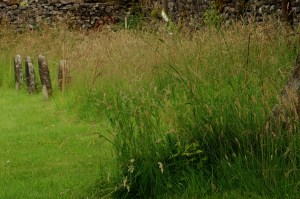
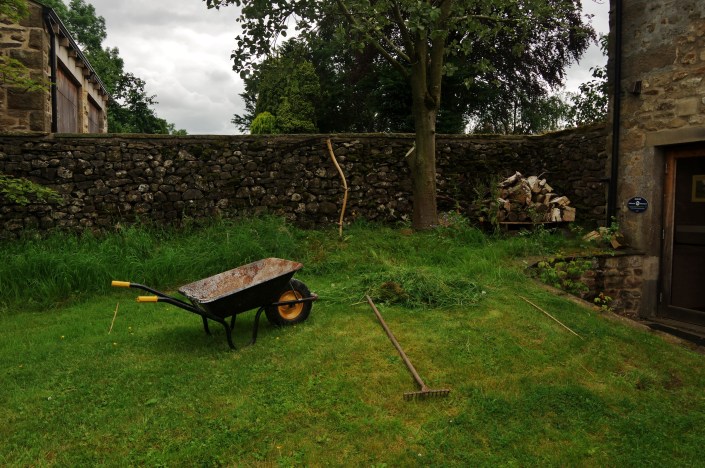
It’s year two of the big biodiversity push in the burial ground, conceived as a strip of meadow grass around two edges. Advice about establishing meadows is as diverse as the list of flowers that you might find in a well-managed sward but the underlying principles are always the same, always based on what is going on ecologically speaking. Crucially, managing a meadow for diversity is all about reducing the dominance of coarse grasses and broadleaved weeds so that more tender herbaceous plants get a chance to shine. And possibly counter-intuitively, the more fertile the soil, the harder that is.
Last year, we planted plugs of Primroses, Red Campion and Ragged Robin – mainly because those were the wildflowers people had growing in their own gardens than for scientific reasons. After flowering I collected seed from the Campions and scattered it throughout the strip – to little effect, as only one campion flower was spotted this year. But the Primroses were out in force in the spring and more recently Ragged Robin has graced a number of areas. This year we’ve plug-planted Foxgloves and Teasels; come autumn I’ll sow Yellow Rattle to weaken the grasses and make space for more flowers.
This is all a bit of an experiment and one important variable is the timing and number of cuts. The time of the first cut of the year determines what plants can grow to maturity – earlier cuts meaning that spring flowers are promoted whilst summer flowering plants are excluded. We’re interested in establishing a diverse sward that peaks in mid-summer, so July is the earliest cut. The factor that governs the rest of the year is a deeply practical one: I’m using a scythe and as a novice am rather slow about it, so a couple of cuts per year is about all I can spare time for. The second cut, made at some point in late summer, is the last bit of attention the meadow will get before winter closes in.
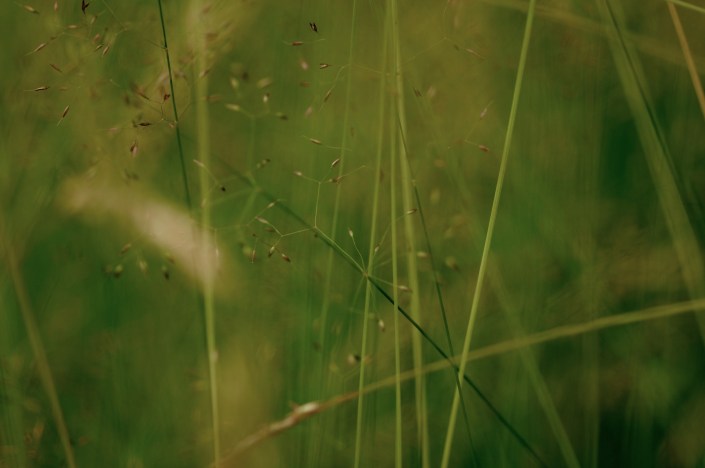
It may not be scientific but what emerges over time will be of interest in and of itself. As things stand, the grasses are still thick and strong, mining what is clearly a richly fertile soil – so in the long run we may be on a hiding to not very much. However, this is an easy disappointment to bear, if indeed one at all. For the grasses themselves, now in full flower, make a beautiful backdrop of their own to the burial ground: a tapestry of stalks and fronds in all heights and textures. Quite unlike the lowly green carpet their neighbours in the lawn are kept to, their different personalities are expressed in all their glory. My particular favourite is the smallest – a delicate tracery of seed heads frothing through the border like a murmuration of tiny starlings, Common Bent (Agrostis capillaris) is much prettier than its name suggests.
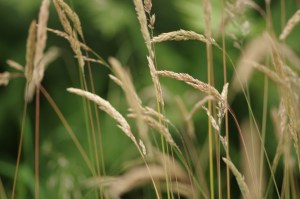
Then there’s the soft, flouncy heads of the Yorkshire Fog (Holcus lanatus) and the rough sawtoothed Ryegrass (Lolium perenne), the bottle brushes of Timothy (Phleum pratense) and the graceful arching heads of Hairgrass (Deschampsia sp.)
But for me it’s the action of scything itself that is its own reward. There’s something tranquilising, even peaceable, about the rhythmic swinging of the blade, as the weight of the snath (the main length of the scythe) draw it firmly and – with practice – evenly through the sward. The feel and sound of the stroke, combined with the sense of bodily rhythm and control are themselves a meditation; the gradual, transformative progress through space lends purpose and satisfaction to the task. This is not an activity to be carried out in haste or anger – rather, with patience, concentration and a still mind. Tiring it may be but no sooner have I put the scythe away I’m looking forward to the late summer cut, when it’s year’s work will be completed.
 Airton Friends' Meeting House and Barn