Uncategorized
A cry for Manchester: when words fail
Sometimes there are simply no words. Thoughts and sentiments beat the exits of the mind, jumbling together in an incoherent mess. For the time being, no thought, no idea remotely helpful can be formed. There is no response but shock and no help but silence.
Such is the reaction I find myself locked into this week. Appalled and stunned along with the rest of the nation, I watched and listened in tears to the news as the awful experiences of ordinary people were described. Innocent people caught up in the consequences of one of the most disgraceful acts of barbarity ever committed on these islands. I’ve struggled to comprehend what could make it possible for any person, let alone one born into our own tolerant, multi-cultural society, to destroy the lives of dozens of people including children, wrecking their families, obliterating their potential. I’ve rallied to the sight of thousands gathering in Manchester’s Albert Square determined to express their solidarity and strength, their willingness to come to each other’s aid and to fight hatred with the far more powerful common bonds of love. And I’ve asked myself how it’s possible that these two extremes can so evidently co-exist amongst us; and which will ultimately shape our future most strongly.
In struggling with these questions I quickly realise that even if there are answers, I’m the least capable of finding them. These events are far from not only my experience but mercifully, perhaps that of most people. We who are spared exposure to this kind of suffering can only watch in sorrow, mourn with the bereaved, support those whose work it is to rescue and relieve, and calmly and rationally assist those whose responsibility is to prevent and protect. But perhaps the most useful thing for the majority to do is to give space to real discussion about the things which threaten peace, educating ourselves about the whole society in which we live and move and in our public conversations and debates allowing all issues to be examined that might influence the decision of a person to commit unspeakable crimes.
For now, however, I return to silence: a space in which I can by feeling the mix of horror, pity, despair, solidarity and hope reaffirm the connection I have with the communities in Manchester and everywhere scarred by brutal acts of violence. They it is who will rebuild their own cities but they can do so in the knowledge that people around the world stand with them, pray with them and will support them in peace and friendship as they strive to overcome their present darkness.
A ride around Malham Tarn
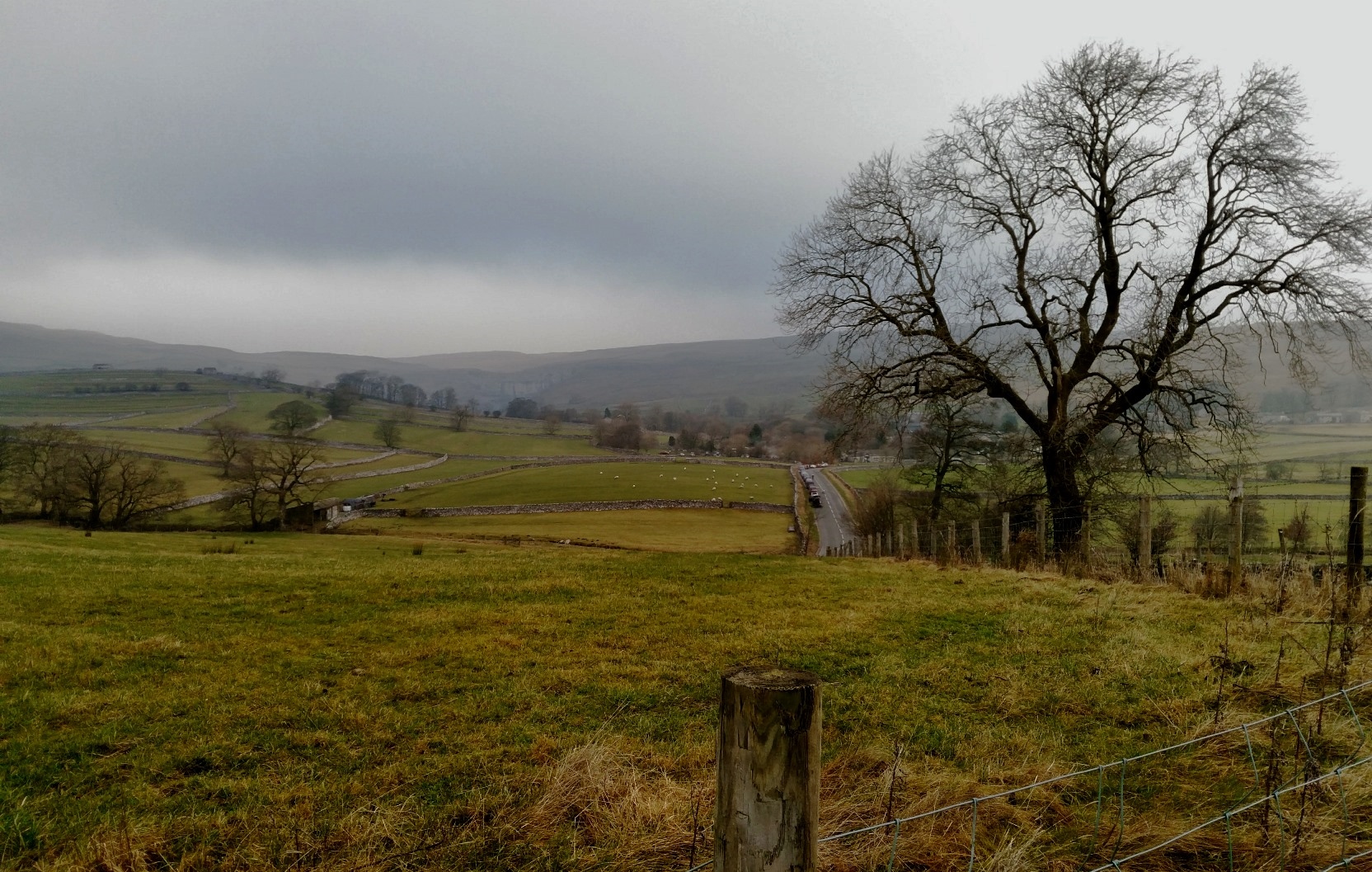
It’s an unpromising looking morning of the sort that in many locations would inspire me to stay in and do precisely nothing; but in the Yorkshire Dales landscape there’s no such thing as a lack of promise, be the sky leaden and the prospect ever so bleak. The late dankness has been replaced by a spell of dry weather, though the clouds still loom low over the hills. So, with no pressing engagements I set off on a cycle ride, determined to reach Malham Tarn – amazingly for the first time.
The great wall of landscape centred on Malham Cove and stretching to either side taking in Pikedaw Hill to the left and Gordale Scar to the right is an imposing barrier approached on a bicycle in the best of weathers. In the lowering cloud cover on this January Saturday it’s enough to make me contemplate turning this into a little jaunt to the Old Malham Café for a relaxing brew and a slice of their fabulous Yorkshire Curd. However, dogged determination to make the most of a rare dry day spurs me on to tougher if not greater things.
I’m no sports cyclist by any means, normally using the bike to get from A to B with a maximum range of a few miles – so I have to grit my teeth to make the ascent out of the village along Malham Rakes – a climb almost as demanding as High Hill Lane out of Settle and at least as long. Before long I realise I’m making slower progress than a very nonchalant looking hiker a few dozen yards ahead, especially as I keep stopping – to admire the view of course… That view fades and bleakens gradually as I climb into cloud so that as the gradient finally flattens out the cycle ride and in fact whole landscape take on a completely different complexion. Up here on the moor, the moist air is still, silent and bitterly cold. Everything is either grey or a bleached brownish green. Few trees and even fewer boundaries structure the landscape which seems to be framed only by low hilltops clothed in rough grass and sedges. It may not sound convincing as a beauty spot but actually this eerie emptiness is one of the things the north of England does really well; and to the busy soul drunk on the bustle of urban life (as I suppose I used to be before moving to Airton), a bit of isolation goes down quite nicely.

I plan to circumnavigate the Tarn and choose the clockwise route, bearing left to stay on the tarmacked road past the watersinks car park. Watersinks is a prosaic and aptly descriptive name for the spot where Malham Water peters out in the grass on its journey to the base of the cove where it re-emerges as Malham Beck – a strange surrender of a river to the ground which only adds to the mystery of this wild place.
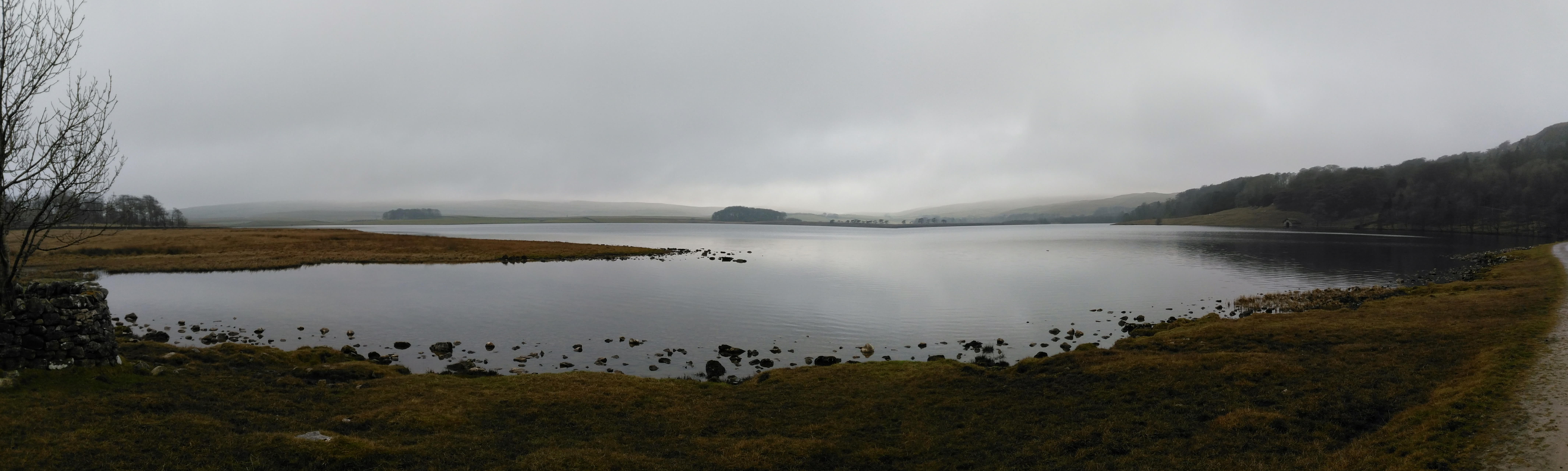
Looping north along Cove Road I still haven’t caught sight of the Tarn, which as waterbodies go seems remarkably well concealed. Not until passing through the edge of some woods along the Pennine Way bridleway does the shoreline appear between the trees. It’s an entrance to beguile the most cynical of travellers (if there are such people…). Having climbed a thousand feet up a seeming vertical highway, here in the clouds I find a lake of tranquil beauty surrounded not by peaks but gentle shores of an almost fenland character. It’s as though the world has quietly reorganised itself while I was looking at the road, putting things the opposite way around to where they ought to be. But it’s all real – as is the bird hide I take shelter in to drink in the amazing serenity of it all.
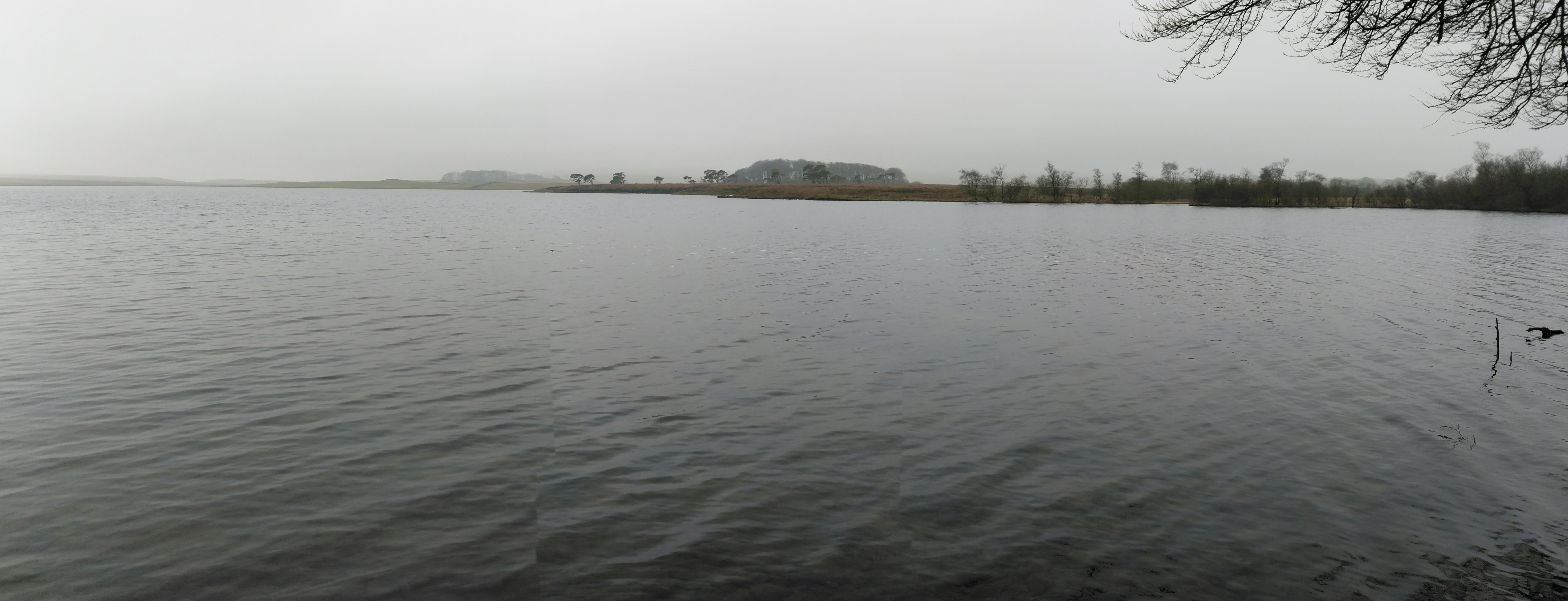
As for the birds, apart from a few tufted ducks and coots near the opposite shore, most of the many species of wildfowl that habituate the Tarn are keeping out of sight – possibly not very impressed by the temperature. And were it not for the cold I could stay here all day with a good book and a pair of binoculars but there’s something else on this ride I’m quite looking forward to: freewheeling more or less all the way back down to Malham – about the most fun you can have on a bicycle, due deference to oncoming walkers & vehicles excepted. And this being a bike ride rather than a walk, I’m back in Airton in time for a warming lunch of soup & home baked bread by an open fire.
A time to welcome the outsider
Opinions differ on whether we’re to have a cold winter or a repeat of last year’s dreary murk. In the cities, where roads are well gritted, gas mains reach every household and there are hundreds of corner shops and supermarkets to hop into when the milk runs out, a blast of snow in early November might have seemed like reassurance that climate change hasn’t had the last laugh – at least yet. Out here in the Dale, a deep freeze would be somewhat more inconvenient. Either way, whatever winter throws at us we’ll need to be prepared.
In this year of upheavals in the national and international political climate it can be tempting to take on the uncertainty of the world in our lives, by putting off decisions perhaps, tightening our belts and focussing in on our own immediate concerns. I know that can happen in my case anyway. But turning inward doesn’t stop the problems of the world from building up.
A few days after the Charlie Hebdo massacre nearly two years ago I was reviewing papers on a breakfast radio show. Pressed by the presenter for some kind of response I reached for the nearest cliché, saying that at these times instead of turning away in suspicion from people we think we have little in common with we need to reach out to exactly those people. It wasn’t especially profound but it was said as much to myself as to the listeners. Those people are the newcomers, people in other ethnic or cultural groups, people in our workplaces we thought we didn’t like, the side of the family we don’t see any more, neighbours with alternative political views, refugees… Looking people in the eye and thinking ‘you’re as valuable as me, and what hurts you hurts me’ can be challenging when we’ve our own worries; but it’s what makes communities and society at large work. If only we could manage that at a global level too we might start looking for and really committing to the solutions to economic degradation, extremism, environmental destruction and climate change.
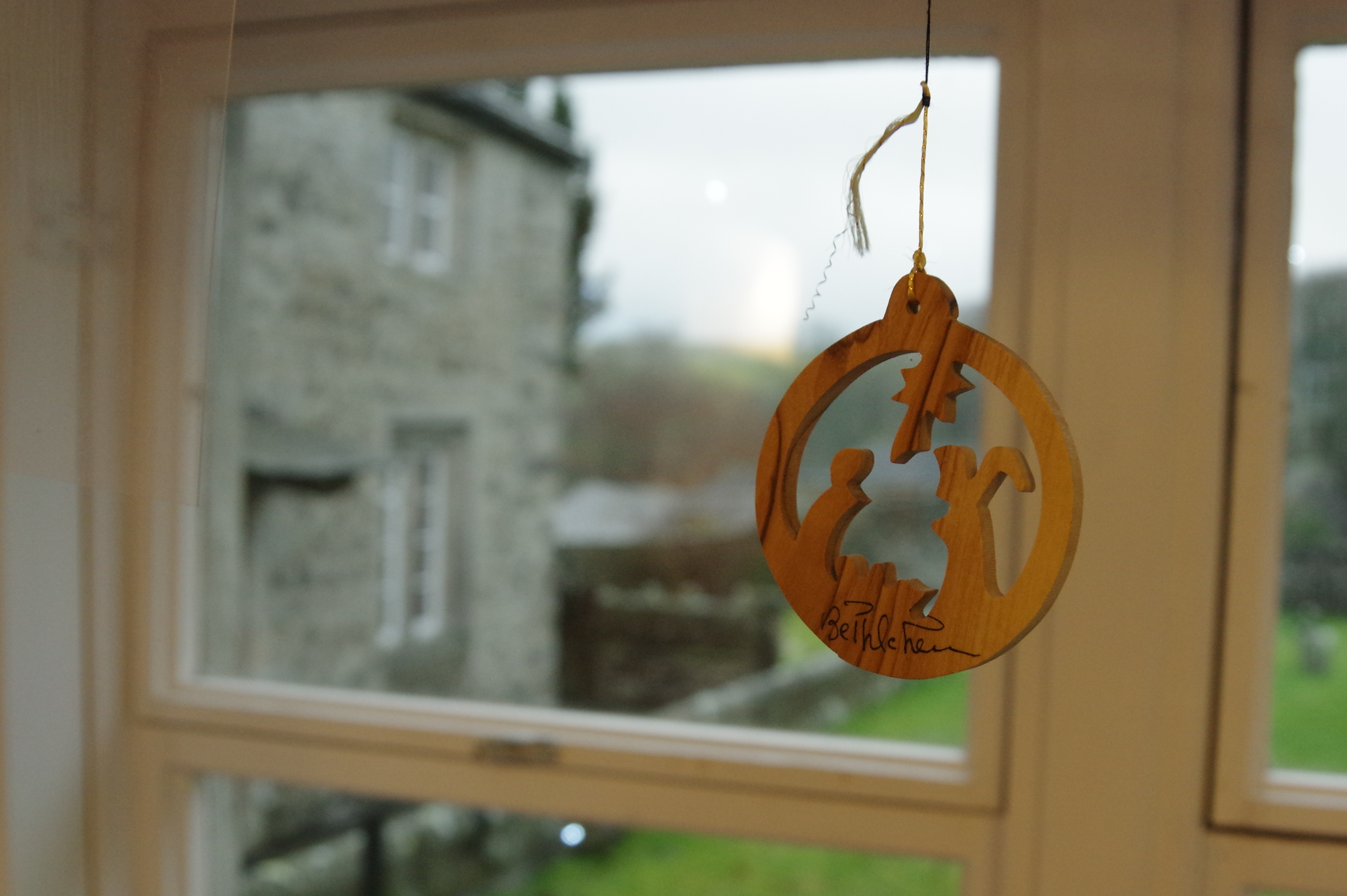 Writing this in mid-December I could hardly blame readers from wondering why I haven’t explicitly mentioned Christmas yet – in fact at this point you might be forgiven for imagining saying ‘bah humbug!’ But perhaps I have been talking about just that… Experienced by probably the majority in this country as a time for families to draw in together, huddling round a hearth or its modern equivalent, the 42” TV, the message of the Christian Christmas is at least in part almost the exact opposite of that cosy vision. It’s a message that I’m reminded of whenever I greet visitors to the Meeting House or Barn. It’s that the outsider sometimes holds something far more valuable than we can supply on our own or from our innermost circle: the invitation to look outwards and upwards to the wider world, to sound the depths of our humanity and realise the potential for human communities when all people are included. Now that’s something really worth preparing for, winter or summer.
Quakers may not mark Christmas in their worship but as individuals we do join in with the seasonal fun & festivities… so if you’re reading this in December, have a very happy and restorative Christmas – and we’ll look forward to seeing you in 2017!
In the third and final blog of this autumn walking series, Simon explores Weet’s Top on a frost-bitten November day

It was the morning stroll that turned into a day-long ramble. Intrigued to discover the secrets laid by the night’s frost, I set out with camera to the riverside, snapping rime covered seed heads and fronds of fern, swapping lenses between close-ups and landscapes with frigid fingers unused to the sudden cold.
The magical beauty is unsurprising to anyone who has seen ice before; what draws me on are the striking patterns of ebb and flow on the hillside opposite. Parallel rises and falls strafing the surface of the ground, these ‘lynchets’ were caused by the transverse ploughing of a slope by a single farmer, unlike the multiple parallel land holdings indicative of ‘ridge and furrow’ elsewhere. Now in the relief of light and shade thrown by the low sun on the frozen earth, the sculpted hillside tells its history more clearly than in any other kind of weather.

Exploring these undulating fields rising east of the river leads to the hamlet of Calton and a decision point: do I turn clockwise back home for elevenses and to get on with the day or make a longer loop anti-clockwise to see what lies beyond? There’s an enticing high point on the map not far away and the views on a clear late autumn day would be stunning… There is no contest, so I turn north-eastwards to the bridleway up to Weet’s top.
It’s not long before the decision is vindicated. Rising above the tree line not far from Calton, the view opens out to envelop most of Malhamdale, the grizzled southern edge of the Dales and the Aire valley around Skipton, reaching beyond to the hills of West Yorkshire, south-west to the magnificent gritstone plateau of Pendle Hill and west to the rolling horizon of Bowland in Lancashire. This skyline is familiar but what is breath-taking today is the spectacular temperature inversion that has spread mist like white butter on the valley floors, punctuated only in the foreground by tree tops and rises, so that the landscape unfurls below like the dishevelled humps of an unmade patterned duvet.

From here upwards there is little shelter, so that the sun has thawed most of the frosted ground; but in places walking alongside minor ridges I find my right foot connecting with hard, frozen ground while my left lands on soft, sun-soaked earth. It’s the line between autumn and a winter that’s all too eager to establish itself here by late November – perhaps the reason why I meet so few walkers on what is a perfect day to be out on the hill.
The path to Weet’s Top is long and straight, rising gradually and easily across the rush-flecked moor. It’s such an inconspicuous peak that unless it were marked by a trig point I might have walked on past. But it’s the highest point for some distance, giving a panoramic view of the southern Dales and the farther peaks and troughs of the region. Pendle Hill is an ever-present companion on this walk and it’s easy to understand how it caught the imagination of early Quakers as a place inspiring vision and far-sightedness. Other peaks have no less character, each uniquely contributing to a visual feast: Flasby Fell to the south with its jagged ridge line; Thorpe Fell, south-east, with a war memorial marking its summit; the impressive snow-covered flank of Great Whernside closing the view north-west and the grit-strewn slops of Hawksmill Clowder closer to hand in the north to name a few.
On a day that began in the frigid belly of the wintry dale it would be reasonable to expect this exposed spot to be impossibly uninviting; but the sun is strong enough here well above the misted valley to have warmed the still air sufficiently that I’ve been obliged to pack up my outer layers, only replacing my pullover after a brief lunch stop. I retrace some of my steps, hiving off to the right to make a loop of this increasingly extended morning stroll. Up on the moor, away from most boundaries and waymarker posts it’s easy to misjudge one’s direction by a degree or two; I manage to find myself on the wrong side of a steeply sloped gill but notice soon enough to avoid too much of a detour. Veering too far right again it’s on turning back towards the sun that possibly the most exquisite sight so far is revealed: a field of gossamer stretched between the blades of rushes twinkles, vacillating in the light breeze caressing the hillside, its million tiny authors blown away to make their spidery fortunes somewhere else.
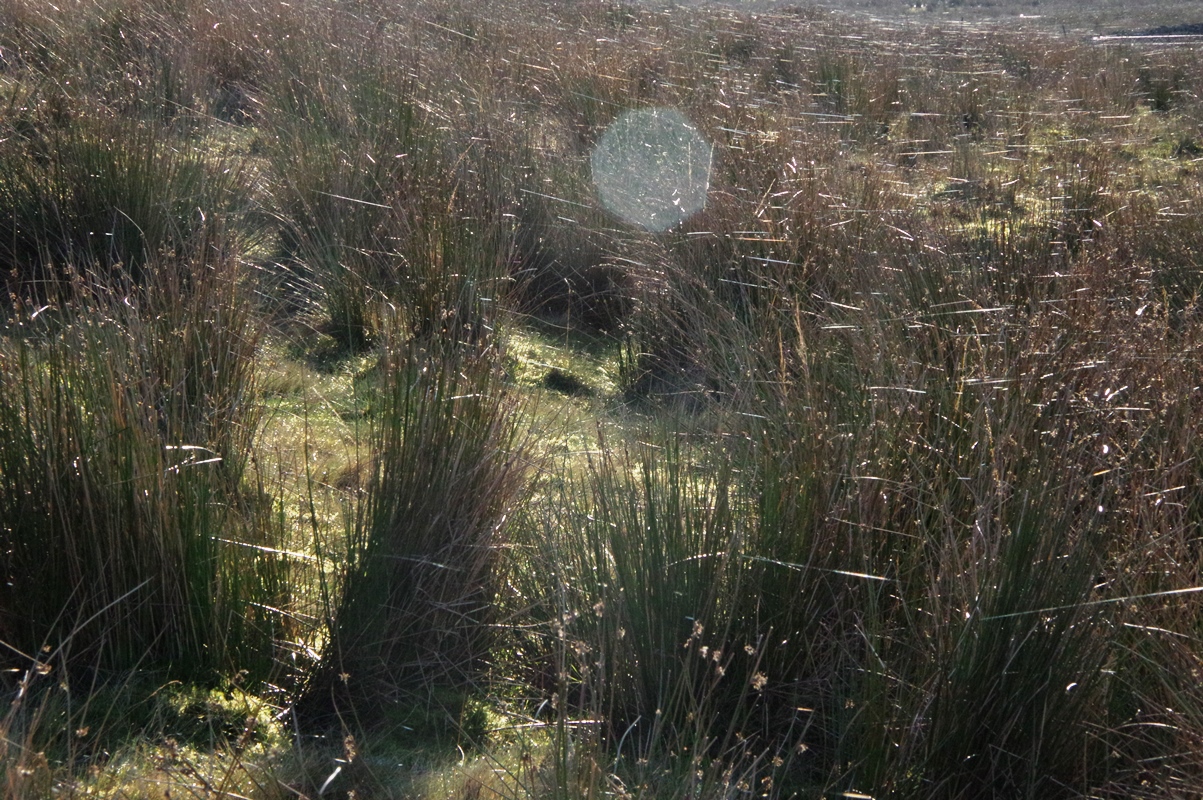
I soon find the track leading down to Hanlith and before long have to replace coat and scarf – the temperature inversion having held all day, it seems as though the air cools by a degree with every step. At the bottom I’m contemplating whether to stop for tea and cake at the Town Head Café in Airton when I slip, not on ice but mud – a reminder that it’s still not quite as cold as it might be in a week or three.
There’s one more delight in store before I get to clean up though. Following a group of three gents with some serious looking binoculars I catch them up at the riverside near Airton where they’ve stopped, looking intently at the trees in the near distance. When asked what’s piqued their interest, they reply ‘the Fieldfares’. Sure enough, hundreds, perhaps thousands of small birds that my untrained eye might have taken for Thrushes are decorating the nearby tree-tops, periodically flitting from one tree to another. Unlike Starlings who appear to act as one organism pulsating in the sky at dusk, these white-bellied birds alight from the trees one by one, the whole troupe unpeeling chaotically from each tree, landing, then moving on soon after in a delicate dance that flecks the air like glitter in a snow globe. Deep in thoughts of hot tea, setting the fireplace and sifting through the photos of the day, I might well have missed this, the last and best sight of the day!
- ← Previous
- 1
- 2
- 3
 Airton Friends' Meeting House and Barn